 comparison
Permeable Pavers vs Traditional Concrete for DFW Homes
Last Updated: November 4, 2026
Quick Summary
Permeable pavers let stormwater infiltrate through aggregate-filled joints into a designed sub-base instead of running off, which suits DFW's expansive clay soil. Their main drawbacks are higher upfront cost and required vacuum sweeping once or twice a year to keep joints from clogging.
- Traditional concrete is impervious and relies on slope and grading alone to move water.
- Vacuum sweeping once or twice a year is the baseline for keeping joints open.
- Check joint aggregate levels twice a year and after heavy rain on sloped drives.
- Laying permeable pavers directly on native clay without an open-graded base is the most common failure.
- Get HOA architectural review approval in writing before you excavate.
Table of Contents
- Permeable Pavers vs Traditional Concrete: A Side-by-Side Comparison
- Advantages of Permeable Paving Systems for DFW Properties
- Downsides and Maintenance Challenges of Permeable Pavers
- Best Pavers for Clay Soil: What Works Under DFW Conditions
- Permeable Paver Installation Cost: What DFW Homeowners Should Expect
- Permeable Paver Maintenance Tips to Protect Infiltration Rate
- HOA Rules and Local Drainage Requirements for Permeable Driveways
- Planning Your Permeable Paver Project with Moises Pizana Hardscapes
- Frequently Asked Questions
Permeable Pavers vs Traditional Concrete: A Side-by-Side Comparison
The pros and cons of permeable pavers for DFW homes come down to one structural fact: this region's expansive clay soil does not drain.
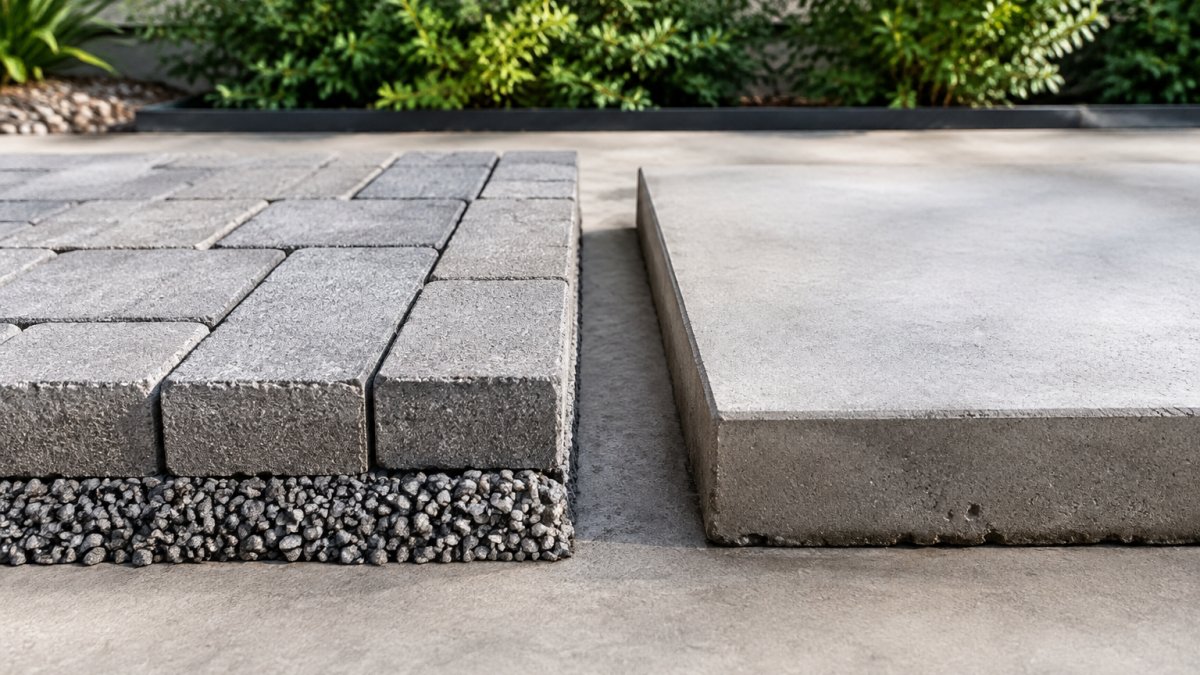
Permeable interlocking concrete pavers are factory-made concrete units laid with narrow, aggregate-filled joints over an open-graded base, so stormwater runoff infiltrates the surface instead of sheeting off it. Traditional concrete is a continuous, impervious surface that relies on slope and grading alone.
| Feature | Permeable Pavers | Traditional Concrete |
|---|---|---|
| Water handling | Infiltrates through joints and base | Runs off to grade or a drain |
| Joint maintenance | Vacuum sweeping, aggregate refill | None |
| Crack behavior | Units flex, settle independently | Slab cracks as soil moves |
| Repair scope | Replace individual units | Break out and repour |
| Best for | Drainage problem spots, parking pads | Flat, well-drained, low-traffic areas |
How Permeable Interlocking Concrete Pavers Handle Water
Water never sits on a permeable paver surface. It drops through the joint aggregate, filters through a geotextile fabric, and collects in a graded stone reservoir before soaking into the subgrade or leaving through a drain. The void space in that aggregate layer is the whole system. Fill it with sediment and the driveway stops working.
Where Traditional Concrete Falls Short in DFW
A concrete slab is a lid on clay. When soil saturation builds underneath, hydrostatic pressure has nowhere to go, so it finds the weakest point: a control joint, an edge, or your slab's first hairline crack. That is why DFW driveways crack along the same lines year after year. The concrete is rarely the problem. The trapped water is.
Advantages of Permeable Paving Systems for DFW Properties
The strongest case for permeable paving systems is erosion control. DFW's clay sheds water fast once it is saturated, and that runoff scours mulch beds, undermines fences, and pools against retaining walls. A permeable surface intercepts rainfall at the source and slows it down.
Other advantages we see on our projects:
- Standing water disappears. Parking pads and low spots stop holding puddles after a storm.
- Groundwater recharge improves. Water returns to the soil instead of the storm sewer.
- Curb appeal rises. Interlocking units come in far more colors and textures than a gray slab.
For a closer look at how these systems perform in heavy rain, read our guide to permeable driveway solutions for heavy rain, and if you want to see the drainage benefit applied to foot traffic, our walkthrough on how to install permeable walkways for drainage covers the practical side.
Downsides and Maintenance Challenges of Permeable Pavers
Clogging is the real cost of permeable paving. Sediment accumulation in the joint aggregate and surface pores reduces infiltration rate over time.
Water enters through the joints, passes a geotextile filter, and is temporarily stored in the void space of the graded stone reservoir before infiltrating the subgrade or leaving through an underdrain.
The honest list of drawbacks:
- Vacuum sweeping is required. Regenerative-air or vacuum sweeping is the only reliable way to pull embedded sediment out of the joints and surface pores. Once or twice a year is the baseline, but tree canopy and adjacent bare soil drive frequency higher.
- Joint aggregate needs replenishment. Washout happens, especially on slopes. Check joint levels twice a year and after heavy rain on a sloped drive.
- Upfront cost runs higher than a plain slab. The premium comes from extra excavation, thicker open-graded base, geotextile, and labor to compact in lifts, not from the pavers alone.
Watch out: laying permeable pavers directly on native clay without an open-graded base is the single most common failure we are called out to fix.
What Maintenance Actually Costs Over Time
Professional regenerative-air sweeping is a recurring maintenance task, not a one-time fix. Plan for it as a regular expense that protects the surface.
Sediment source control is the free half of maintenance. Keep mulch, sand, and bare soil away from the edges, edge beds with stone or established groundcover instead of fresh bark, and direct downspouts away from the paver field.
Best Pavers for Clay Soil: What Works Under DFW Conditions
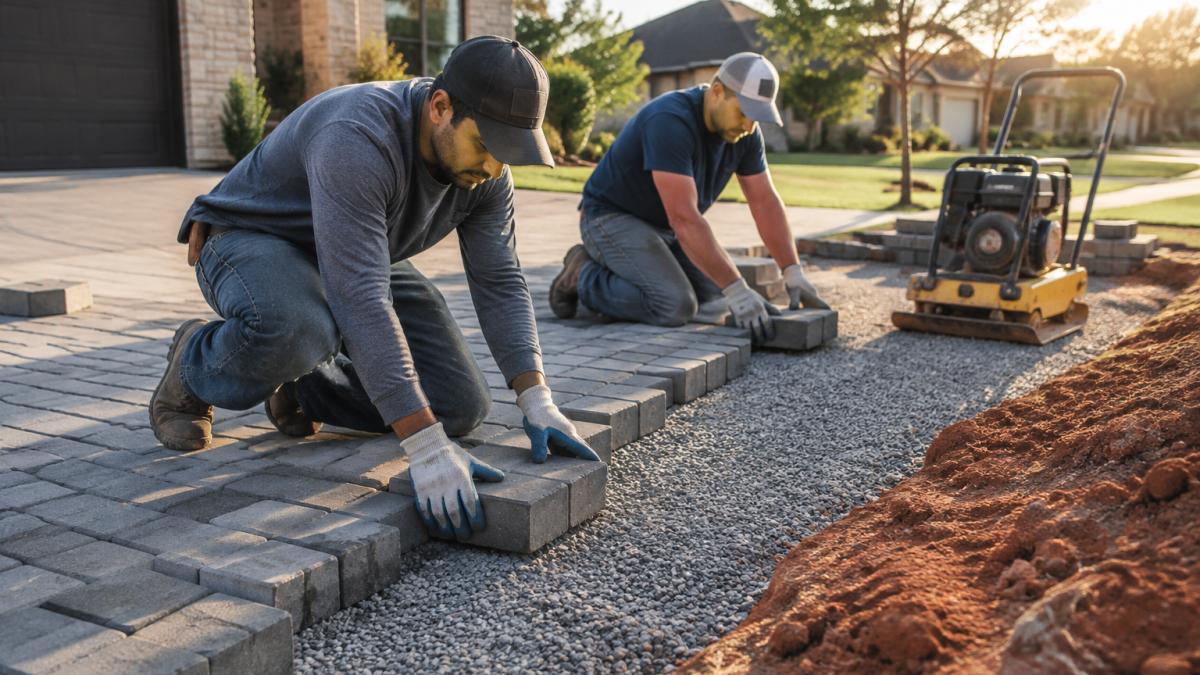
The best pavers for clay soil are dense interlocking concrete units with engineered joint spacing, set on a designed aggregate base, not on native soil. The paver choice matters less than what sits under it.
Sub-Base Design for Expansive Clay
Expansive clay swells when wet and shrinks when dry, and that movement destroys flatwork here. A proper sub-base stores stormwater long enough to infiltrate and separates the pavers from that movement with graded aggregate and geotextile fabric. Base depth and compaction are the load-bearing decisions on the whole project. Our guide to the best base for a paver walkway in DFW walks through the layer-by-layer detail.
Freeze-Thaw and Soil Saturation Performance
North Texas freeze-thaw cycles are short but sharp, and they punish saturated ground. Permeable systems handle this better than slabs because individual units flex rather than crack under movement, and the open base gives expanding water somewhere to go. For a wider look at which features hold up here, see the best hardscape features for Fort Worth soil conditions.
Permeable Paver Installation Cost: What DFW Homeowners Should Expect
Permeable paver installation cost depends on square footage, base depth, excavation, and grading, so pricing varies by project. Visit the Moises Pizana Hardscapes website for current pricing or a quote.
What drives the number up or down:
- Base depth required by your soil and drainage conditions
- Excavation and haul-off of clay spoils
- Drain connections if the site needs an overflow route
We quote each project after walking the site. Request a quote from our Grapevine Hardscapes team for a real number on your property.
Permeable Paver Maintenance Tips to Protect Infiltration Rate
Permeable paver maintenance tips boil down to keeping the void space open. Two tasks do most of the work: vacuum sweeping and joint aggregate refill. Everything else is inspection.
Vacuum Sweeping and Sediment Control
A regenerative-air or vacuum sweeper pulls embedded sediment out of the joints and surface pores. Schedule it in spring after pollen and in fall after leaf drop. Keep mulch, sand, and bare soil away from the edges, because those are the sediment sources that clog the system fastest.
Joint Aggregate Replenishment Schedule
Check joint levels twice a year and top off with the same open-graded aggregate the system was built with. Never fill joints with sand or dirt. On sloped driveways, inspect after heavy rain for washout.
HOA Rules and Local Drainage Requirements for Permeable Driveways
Local HOA rules and municipal drainage requirements vary from city to city across the region. What actually determines whether your project gets approved is the documentation you submit and the order in which you get approvals, so treat this as a permitting sequence, not a checkbox.
How HOA Architectural Review Treats a Permeable Driveway
Most associations regulate driveways through an approved-materials list, a design review application, and sometimes a covenant limiting impervious cover. A permeable driveway usually clears the materials list because it is still interlocking concrete pavers, but the sub-base and edge restraint are what the reviewer will ask about.
A common pattern is that approval hinges on three submissions:
- A materials spec sheet from the paver manufacturer showing the permeable line, unit dimensions, and joint aggregate specification.
- A cross-section drawing showing excavation depth, open-graded base thickness, geotextile placement, and edge restraint detail. Reviewers want to see that the system is engineered, not improvised.
- A site plan showing where water goes, infiltration into the subgrade, an underdrain, or an overflow route to grade, and how the driveway meets the street or alley without sending runoff onto a neighbor.
Get the architectural review approval in writing before you excavate. Retrofitting a completed driveway to satisfy a covenant is expensive, and some associations require the homeowner to restore the surface at their own cost if work starts without approval.
Municipal Drainage and Impervious-Cover Rules
Municipal requirements are separate from HOA rules and can be stricter. Many cities administer stormwater through a drainage utility or engineering department, and the trigger for review is usually the amount of new impervious cover added, not the paver type.
Before you buy a single paver, confirm these with the city and your association:
- Your HOA's approved materials list and design review process, with approval in writing
- Your city's drainage and impervious-cover thresholds and whether permeable surfaces are credited differently
- Whether a permit, grading plan, or engineer's letter is required for your square footage and slope
Watch out: assuming a permeable driveway is automatically exempt from impervious-cover limits is the most common compliance mistake we see.
What to Bring to the Counter
Bring the manufacturer's permeable product literature, the cross-section, the site plan with flow arrows, and a short written description of the sub-base design and overflow route. Projects that stall almost always stall on missing documentation, not on the merits of permeable paving. If your site has expansive clay and the design relies on infiltration, be prepared to explain how the base stores water during a saturated period and where the excess goes.
Planning Your Permeable Paver Project with Moises Pizana Hardscapes
The pros and cons of permeable pavers for DFW homes favor the system when drainage is your actual problem and you will commit to upkeep.
Moises Pizana Hardscapes does not subcontract the work. Our own crew, with more than 15 years of experience, handles design and installation, from driveways and retaining walls to patios, pool decks, and outdoor kitchens.
Contact Moises Pizana Hardscapes to discuss your project and request a quote.
Frequently Asked Questions
What are the downsides of permeable pavers?
The main downsides are higher material and installation cost than traditional concrete, and ongoing maintenance to keep joints and void space from clogging with sediment. Without periodic vacuum sweeping, the infiltration rate drops and standing water can appear. In DFW's clay-heavy soil, the sub-base must be engineered correctly or the system will not drain as designed.
Are permeable pavers worth it for DFW homes?
They are worth it when drainage is a real problem. DFW's expansive clay soil and heavy spring rainfall create surface runoff, soil saturation, and standing water on impervious surfaces. Permeable pavers address those issues while improving curb appeal and supporting groundwater recharge. If your property already drains well and budget is tight, traditional concrete may be the simpler choice. The value case is strongest for driveways and parking pads that flood.
What goes under permeable pavers?
A permeable system uses layered aggregate, not a solid concrete slab. From the bottom up: compacted native soil, geotextile fabric, a washed crushed stone sub-base sized for the load, a thinner bedding layer of smaller aggregate, then the pavers with open-graded joint aggregate swept into the gaps. The void space in the stone layers stores water while it infiltrates. For clay soil, the sub-base depth and drainage coefficient must be sized to handle slow infiltration.
How often do permeable pavers need maintenance to prevent clogging?
Plan on vacuum sweeping at least once a year, and twice a year if your driveway sits under trees or near loose soil. Replenish joint aggregate as it washes out, and inspect after heavy storms for sediment accumulation. Following these permeable paver maintenance tips keeps the infiltration rate close to the original design. Skipping maintenance is the most common reason permeable systems fail to manage stormwater runoff over time.