 ultimate-guide
The Best Hardscape Features for Fort Worth Soil Conditions
Last Updated: October 29, 2026
Quick Summary
The best hardscape features for Fort Worth soil conditions are flexible surfaces that tolerate clay movement, such as interlocking concrete pavers on a compacted aggregate base, segmental block retaining walls with geogrid, and flagstone on aggregate. Permeable pavers suit poorly draining clay, while poured concrete slabs should be avoided on sites with seasonal movement.
- Identify whether your site has uniform expansive clay, variable fill soil, or compacted poorly draining clay before choosing a feature.
- Flexible surfaces distribute soil movement across many small joints and units, so they stay serviceable when the base shifts.
- Retaining walls need footings below the active zone and drainage gravel backfill, never clay spoil.
- Avoid poured concrete slabs on grade wherever the soil shows seasonal movement.
- Gravel paths on geotextile are a cheap, flexible option for variable fill and low-traffic areas.
Table of Contents
- Why Fort Worth Soil Conditions Break Ordinary Hardscapes
- Hardscape Features That Perform on Clay Soil
- Paver Driveway Base Preparation That Survives the Seasons
- Hardscape Drainage Solutions for Runoff and Stormwater
- Retaining Walls for Clay Soil: Foundation and Backfill Details
- Pavers vs Concrete Driveway: Which Handles Movement Better
- Rock Mulch, Organic Mulch, and Planting Beds Around Hardscape
- Get a Quote for Hardscape Built for Your Soil
- Frequently Asked Questions
Why Fort Worth Soil Conditions Break Ordinary Hardscapes
The best hardscape features for Fort Worth soil conditions are the ones designed around expansive clay, not against it.
Hardscape features are the built elements of a landscape such as driveways, walkways, patios, retaining walls, and pool decks that use paving and structural materials instead of plants. In North Texas, the soil underneath those features moves, and the movement is the whole story.
How Expansive Clay Moves Under Patios and Driveways
Clay soil swells when it absorbs water and shrinks as it dries, and the Dallas-Fort Worth region sits on some of the most active clay in the state. A slab poured directly on grade gets pushed and pulled from below, which shows up as cracks, settled corners, and doors that stop latching on outdoor structures.
The fix is not thicker concrete. It is a base and foundation design that isolates the surface from soil movement, and that starts with reading the site.
Reading Your Own Yard: A Quick Site Diagnosis
- Cracks in existing concrete that run diagonally or widen seasonally
- Soil pulling away from the foundation or from walkway edges
- Water that ponds for more than a day after rain
Hardscape Features That Perform on Clay Soil
Features that perform here share one trait: they tolerate movement or they manage water. But "tolerates movement" is not a single property, and the right feature depends on which soil condition you actually have.
Start With the Diagnosis, Not the Feature
Before choosing a surface, identify which of three soil conditions describes the site:
- Uniform expansive clay with seasonal movement. Cracks widen in late summer and close after fall rains. This is the most common condition in the region.
- Variable fill or cut-and-fill soil. Part of the yard was graded or backfilled during construction, so one corner moves differently from another. Look for a step in the fence line, a slope that changes abruptly, or paving that settled on one side only.
- Compacted or poorly draining clay. Water stands for a day or more after rain, and a shovel or soil probe meets resistance within a few inches. This condition punishes any feature that traps water.
Two or more of these can overlap on the same lot. The feature recommendations below are keyed to these conditions.
Feature-by-Condition Selection Guide
| Feature | Best-Fit Soil Condition | Why It Works | When to Avoid It |
|---|---|---|---|
| Interlocking concrete pavers on compacted aggregate base | Uniform expansive clay; variable fill | Individual units flex with minor movement and can be lifted and reset | Sites with standing water and no drainage plan, the base will pump and fail |
| Segmental block retaining wall with geogrid | Variable fill; sloped lots | Units flex and drain; geogrid ties the wall into stable soil behind the active zone | Walls over about 4 ft tall without engineered design |
| Flagstone on aggregate base | Uniform expansive clay | Tolerates settling and is repairable unit by unit | High-traffic driveways, joints loosen under vehicle loads |
| Permeable pavers or permeable joints | Compacted, poorly draining clay | Lets water pass through the surface instead of sheeting to the foundation | Sites where the subgrade itself will not infiltrate, the base must still drain |
| Gravel path on geotextile | Variable fill; low-traffic areas | Cheap, flexible, and easy to re-grade | Slopes steeper than about 5 percent without a retention edge |
| Poured concrete slab on grade | Stable, well-drained soil only | Lowest upfront cost and fastest placement | Any site with seasonal movement, cracks are inevitable and hard to repair invisibly |
The Mechanism That Separates Winners From Failures
Rigid surfaces, poured concrete, mortared stone, tile, transfer soil movement directly into the surface, so a swelling clay subgrade pushes the slab up and a shrinking one lets it settle.
That is why the base matters more than the surface. A paver installed on a properly compacted, graded aggregate base behaves like a flexible system.
Texas A&M AgriLife Extension guidance on expansive clay soils explains why soil moisture swings drive so much structural damage in the region.
Materials We Steer Clients Toward for Local Conditions
For most residential sites here, interlocking concrete pavers on a compacted aggregate base and engineered segmental block walls with geogrid and free-draining backfill are the default recommendations. Flagstone on aggregate is a good fit for patios and garden walks where repairability matters more than a perfectly even surface. Poured concrete remains common because of its upfront cost, but on active clay it should be treated as a maintenance item rather than a permanent surface.
Paver Driveway Base Preparation That Survives the Seasons
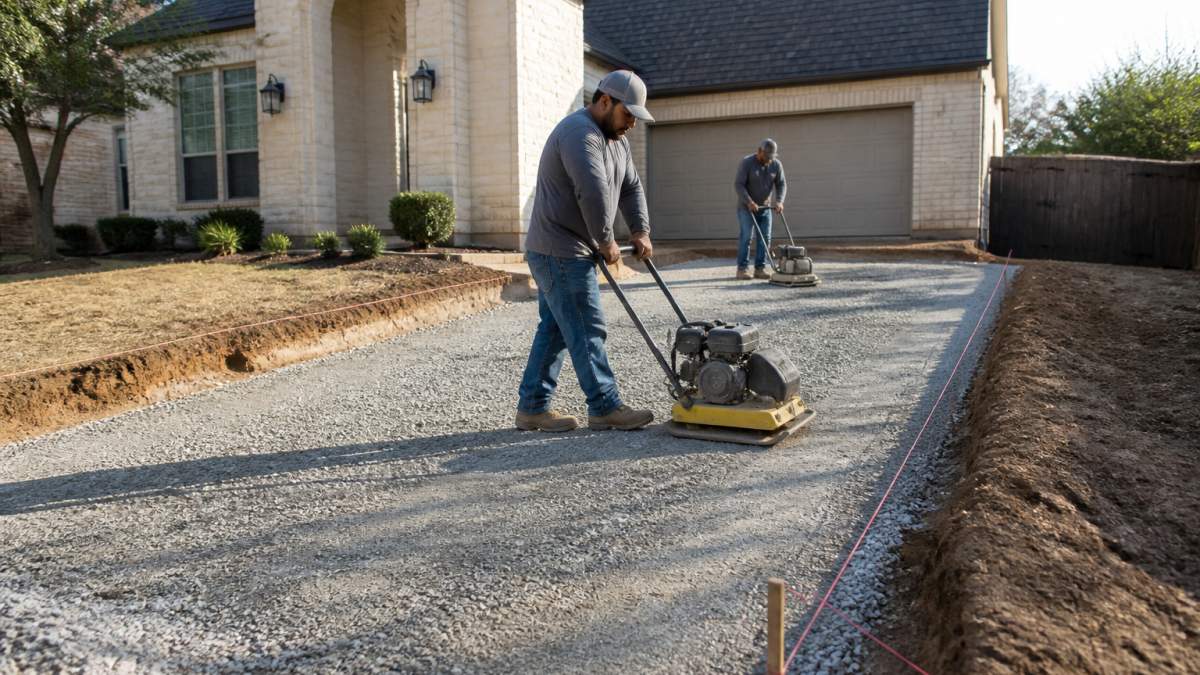
For a deeper look at regional base specs, our guide to the best base for a paver walkway in DFW walks through layer depths and material choices.
Hardscape Drainage Solutions for Runoff and Stormwater
Our article on permeable driveway solutions for heavy rain covers options that let water pass through the surface instead of sheeting off it.
Retaining Walls for Clay Soil: Foundation and Backfill Details
Retaining walls for clay soil need a foundation that reaches below the active zone and a backfill that drains. Those two details, footing depth and backfill drainage, decide whether a wall stands for decades or leans within a few wet seasons. Most wall failures we are called to repair trace back to one of them, not to the block.
Why the Active Zone Matters
The active zone is the depth of soil that swells and shrinks with seasonal moisture. In expansive clay, that movement exerts lateral pressure against a wall and can lift or settle its footing. A wall founded within the active zone rides that movement; a wall founded below it sits on more stable soil and resists it.
Foundation and Footing Details
- Excavate to stable subgrade. Remove organic material and any soft or disturbed clay before placing the footing.
- Use a compacted aggregate footing. Angular crushed stone compacted in lifts gives a drained, stable base for the first course.
- Set the first course level and buried. The bottom block should be fully supported and partially buried to resist sliding.
Backfill That Drains
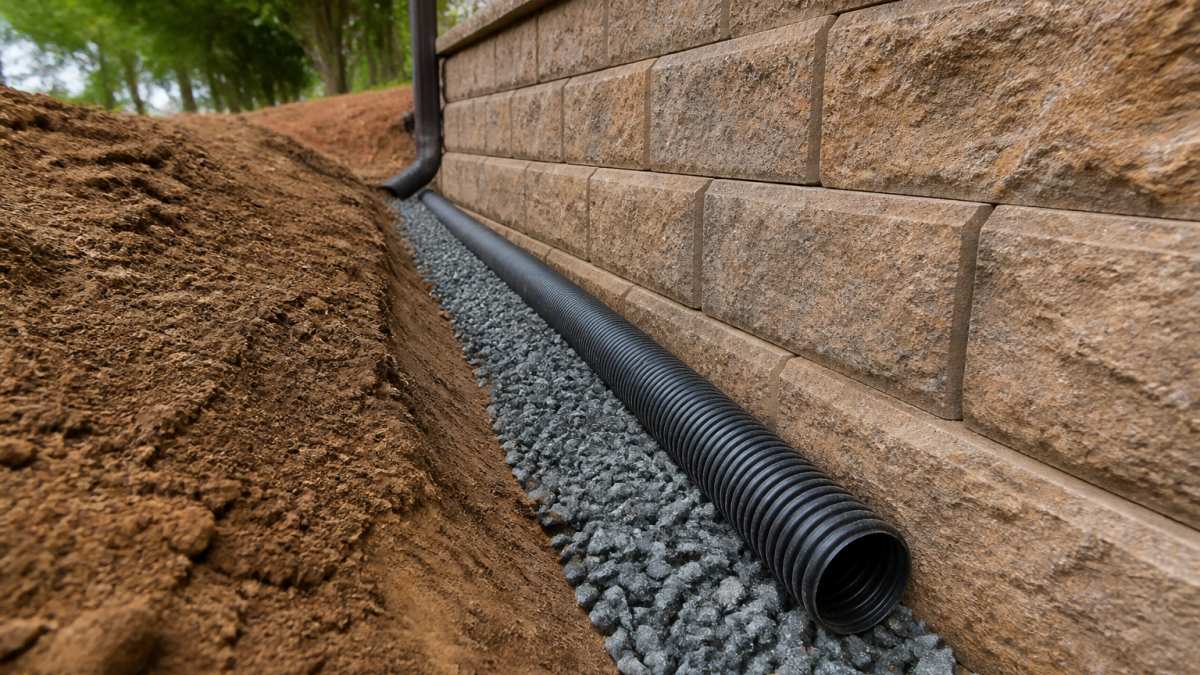
- Drainage gravel, not clay spoil. Backfill the zone behind the wall with clean crushed stone.
- Filter fabric between stone and soil. Wrap the stone so fine clay particles do not migrate in and clog the drainage layer.
- A drain at the base. A perforated pipe in the gravel, daylighted to a safe outlet, carries water away from the wall.
When to Bring In an Engineer
For the full breakdown, read our article on why retaining wall drainage in clay soil is critical.
Pavers vs Concrete Driveway: Which Handles Movement Better
Our pavers vs poured concrete walkway comparison breaks down cost, durability, and design side by side.
Rock Mulch, Organic Mulch, and Planting Beds Around Hardscape
Planting beds next to hardscape need a mulch choice that accounts for water. Organic mulch breaks down and improves soil over time, but it holds moisture against clay and against wall bases. Rock mulch sheds water and does not decompose, though it reflects heat onto nearby plants and paving. Selecting the right plants for clay soil helps manage these drainage challenges while naturally loosening the earth around your stone borders.
Get a Quote for Hardscape Built for Your Soil
If you are ready to move from planning to construction, you can request a driveway paving installation quote.
Frequently Asked Questions
What hardscape materials work best in expansive clay soil?
Interlocking concrete pavers on a compacted crushed-stone base perform well because individual units can flex with minor soil movement and be reset if settlement occurs. Engineered block retaining wall systems with proper footers handle clay pressure better than stacked stone. Crushed stone, not pea gravel, is the right aggregate for drainage bases because its angular edges lock together. Poured concrete can work but needs control joints and a reinforced base, and it is harder to repair once it cracks.
Do pavers perform better than poured concrete on shifting soil?
In most cases yes. A pavers vs concrete driveway comparison usually favors pavers on expansive clay because the joints between units absorb small movements. If one area settles, the affected pavers can be lifted, the base corrected, and the same units reinstalled. Poured concrete is a single rigid slab, so movement that exceeds its control joints shows up as cracks that require patching or replacement. The catch is that pavers only outperform concrete when the base preparation is done correctly.
How deep should a paver base be for a driveway?
A residential driveway typically needs 6 to 8 inches of compacted crushed stone over a geotextile fabric, placed in lifts and compacted between each one, with about 1 inch of bedding sand under the pavers. Clay sites may require excavation deeper than that to remove unsuitable soil and replace it with stable material. Paver driveway base preparation is the step that decides whether the surface stays flat, so it should never be shortened to save time.
How should a patio be prepared for clay soil?
Start by grading the area so water leaves the patio rather than sitting under it. Excavate to the depth required for base, fabric, and bedding, then compact crushed stone in lifts. Edge restraint matters on clay because without it the pavers spread outward. In areas where soil movement is severe, a concrete footer under the edge restraint adds stability. Keep downspouts and gutter outlets directed away from the patio so the clay does not stay saturated.
What drainage features help protect hardscapes in Fort Worth?
Hardscape drainage solutions usually combine surface grading, a drainage swale, and a French drain or channel drain at the low point. The goal is to move stormwater away from the base before it saturates the clay. Permeable materials and open-graded joint fill can help on patios, but they do not replace a plan for where the water goes. Check that runoff is directed to a legal discharge point rather than a neighbor's property.
Are retaining walls suitable for sloped yards with clay soil?
Yes, when they are engineered for the load. Retaining walls for clay soil need a footer set below the frost line and below the zone of seasonal soil movement, plus free-draining gravel backfill and a drain pipe at the base to relieve water pressure. Engineered block systems are designed for this. A wall built without drainage can fail even if the blocks are heavy, because saturated clay pushes much harder than dry clay.
How can I prevent hardscape features from shifting or cracking?
Three things do most of the work: a properly compacted base, working edge restraint, and drainage that keeps water out of the subgrade. Add annual maintenance, refilling joint sand and checking for low spots after heavy rain. Trees near a patio or driveway also matter, since roots can lift pavers and dry the soil unevenly. If you notice rocking units or new cracks, address them early before the base is compromised.
Fort Worth clay will find every weak point in a build, which is why we design drainage and base work before we ever talk about surface material. Moises Pizana Hardscapes handles retaining walls, driveways, patios, pool decks, and walkways with our own crew and equipment, no subcontracting, backed by more than 15 years of experience. Get started with Moises Pizana Hardscapes and build a hardscape that stays level through every wet and dry season.