 How-to
How to Choose a Retaining Wall Contractor
Last Updated: November 14, 2026
Quick Summary
Choose a retaining wall contractor by verifying their license, insurance, and workers' compensation coverage, then confirming those details yourself with the insurer and licensing authority. Ask how many walls they have built in the past year, request three recent references, and compare at least three written estimates line by line.
- A retaining wall is a structural system, not a landscaping decoration, so hire a contractor who designs for soil and water.
- Ask for the license number, insurance certificate, and workers' compensation proof before any work begins.
- A complete estimate lists excavation, footing, materials, reinforcement, drainage, backfill, permits, and cleanup as separate line items.
- Ask for at least one reference from a project more than two years old to judge drainage performance.
- Walk away from a bid given without anyone visiting the site or examining the slope.
Table of Contents
- What Separates a True Retaining Wall Contractor From a Landscaper
- How to Verify Licensing, Insurance, and Local Experience
- Retaining Wall Contractor Questions to Ask Before You Sign
- What a Complete Retaining Wall Contractor Estimate Should Include
- Retaining Wall Contractor Reviews and References That Actually Tell You Something
- Retaining Wall Contractor Red Flags to Walk Away From
- Get a Quote From a Crew That Builds Walls Every Week
- Frequently Asked Questions
What Separates a True Retaining Wall Contractor From a Landscaper
Choosing the right retaining wall contractor starts with understanding that a retaining wall is a structural system, not a landscaping decoration. A landscaper moves soil and plants shrubs; a retaining wall contractor designs and builds a wall that holds back earth, manages water, and stays put for decades. That distinction decides everything about how you vet the people bidding on your project.
A retaining wall treated like a garden bed border can lean, crack, or fail.
A retaining wall is a structure built to resist the lateral pressure of soil and water behind it. That pressure never stops, which is why wall height, soil conditions, and drainage planning matter more than the finish on the face.
Why Wall Type and Site Conditions Decide Who You Hire
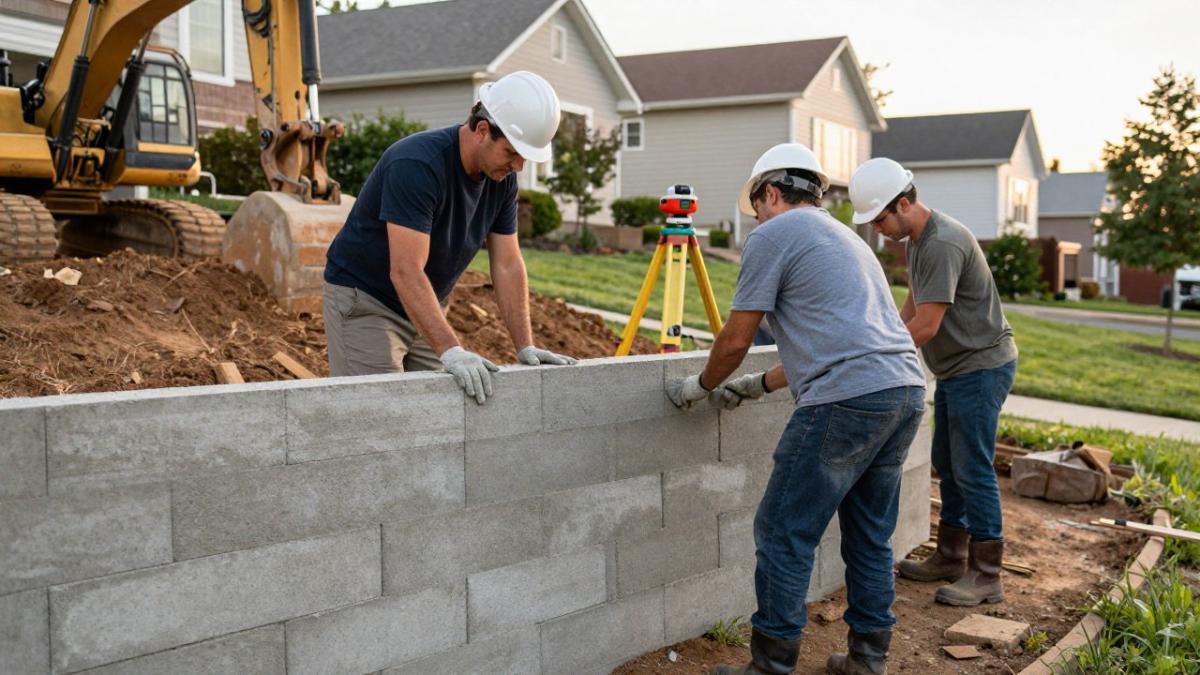
Wall type and site conditions should drive your contractor shortlist, not the other way around. A block wall on a gentle slope is a different job from a tall tiered wall on heavy clay, and the crew you hire needs experience with the type your site demands.
Ask what wall systems they build: segmental block, poured concrete, natural stone, timber, or engineered systems with geogrid reinforcement. Then ask how they handle water. In clay soil, drainage is not optional. Why retaining wall drainage in clay soil is critical explains how trapped water destroys walls that look fine on the surface, and the benefits of geogrid in clay soil show why reinforcement layers matter on sloped lots.
A contractor who cannot explain footing depth, backfill material, or where the water goes is guessing. Guessing is expensive when the wall is holding up your yard.
How to Verify Licensing, Insurance, and Local Experience
Verification is the step most homeowners skip, and it is the one that protects you from liability. Ask for the contractor's license number, certificate of insurance, and proof of workers' compensation coverage before any work begins. Then confirm them yourself by calling the insurer and checking the license with the state or local authority that issues it.
Two policies matter. General liability coverage protects your property if the crew damages a fence, a utility line, or a neighboring structure. Workers' compensation covers injuries on your job, so an injured worker cannot come after your homeowner's policy.
Local experience carries real weight too. A crew that has built walls in your area knows the soil, the grading quirks, and the permit office. Ask how many retaining walls they have completed in the past year and request addresses or photos of recent projects nearby.
Retaining Wall Contractor Questions to Ask Before You Sign
The right questions separate a prepared contractor from a persuasive one. Bring this list to every consultation and write down the answers.
- How many retaining walls has your crew built in the last twelve months?
- Who designs the wall, and does that design account for soil and drainage?
- Will you pull the permits, and who handles inspections?
- What is the footing specification, and how deep will you excavate?
- What backfill and drainage materials are included in the quote?
- What is the project timeline from start to finish, and what delays it?
- Who is on the crew, and is any part of the work subcontracted?
- What does your warranty cover, and for how long?
- Can you provide three recent clients I can call?
Timeline deserves special attention. Our guide to the average retaining wall installation timeline walks through what a realistic schedule looks like, so you can tell whether a promised finish date is honest or wishful.
What a Complete Retaining Wall Contractor Estimate Should Include
A complete estimate is a written scope of work, not a single number on a business card. It should list excavation, footing, wall materials, reinforcement, drainage, backfill, compaction, permits, and cleanup as separate line items. If any of those are missing, the price is incomplete, not lower.
To compare bids fairly, build a simple bid-comparison worksheet. List every scope item down the left column and give each contractor a column of their own. Then check three things for each line: Is the item included, excluded, or listed as an allowance? What quantity or specification is stated? And what is the unit price or lump sum? A bid that says "drainage included" without stating pipe size, gravel depth, or outlet location is not a comparable bid. A bid that lists "permits" as a flat allowance can hide a cost if the jurisdiction charges more.
Watch out: contractors sometimes bury exclusions in the fine print, such as "does not include engineering" or "rock excavation extra", so read the exclusions as carefully as the price. Ask each bidder to confirm in writing whether engineering, permits, inspection fees, and disposal of excess soil are included.
Get at least three written estimates and compare them line by line using the worksheet. A bid that includes engineering, permits, and a drainage system will cost more upfront than one that skips them, and it will be the cheaper wall over its lifetime. If one bid is dramatically lower, the worksheet will usually show which scope items were omitted or downgraded.
Retaining Wall Contractor Reviews and References That Actually Tell You Something
Reviews and references only help if you read them for specifics. Look for mentions of drainage, timelines, cleanup, and how the contractor handled problems. A review that says "great job, very professional" tells you almost nothing. A review that describes a crew fixing a grading issue without being asked tells you plenty.
When you call past clients, ask targeted questions rather than open-ended ones. Good questions include: Did the crew show up when promised, and how many days did the project actually take? Were there any change orders, and how were they priced and explained? Has the wall shown any signs of movement, settling, or water pooling behind it since installation? Comparing how each contractor handled scheduling, changes, and follow-up can also help when choosing a landscape installation contractor for work that extends beyond the wall.
Pay attention to how the contractor responds to criticism online. Every crew gets a complaint eventually. The ones worth hiring answer it directly instead of arguing. Also check whether the contractor's license is in good standing with the state or local licensing board, and whether any complaints have been filed. A pattern of unresolved complaints about drainage or schedule is a warning sign.
Watch out: references supplied by the contractor are usually satisfied customers, so ask for at least one reference from a project that is more than two years old. A wall that has been through several wet seasons tells you more about drainage performance than a wall finished last month.
Retaining Wall Contractor Red Flags to Walk Away From
Red flags are usually visible before the contract is signed, and ignoring them costs more than walking away. Here is what should end the conversation:
- A bid given without anyone visiting the site or examining the slope
- No written contract, or a contract with no scope, timeline, or payment schedule
- A large cash deposit demanded upfront with no milestone payments
- No license number, insurance certificate, or willingness to provide references
- Vague answers about drainage, footing depth, or permits
- Pressure to sign today because the price expires
- No discussion of maintenance or what happens if the wall settles
Our step-by-step guide to maintaining retaining walls and preventing collapse shows what proper upkeep looks like, and a contractor who never mentions it is not thinking past the invoice.
Here is what should end the conversation before you sign anything.
| Red flag | Why it matters |
|---|---|
| Bid given without visiting the site or examining the slope | No site review means the price is a guess |
| No written contract, or one with no scope, timeline, or payment schedule | Nothing protects you if the job goes wrong |
| Large cash deposit demanded upfront with no milestone payments | You lose leverage and control of the money |
| No license number, insurance certificate, or willingness to provide references | You carry the liability for damage or injury |
| Vague answers about drainage, footing depth, or permits | The contractor is guessing on structural details |
| Pressure to sign today because the price expires | Urgency replaces proof of competence |
| No discussion of maintenance or what happens if the wall settles | The contractor is not thinking past the invoice |
Get a Quote From a Crew That Builds Walls Every Week
Vetting a retaining wall contractor comes down to proof: proof of license and insurance, proof of completed walls, and proof of a written scope that accounts for soil, water, and structure. Ask the questions, compare the bids line by line, and call the references. The wall will be there for decades, so the hour you spend verifying is the best investment in the project.
At Moises Pizana Hardscapes, we do not subcontract the work. Our own crew brings more than 15 years of experience and the equipment to build retaining walls, patios, driveways, and outdoor living spaces across the Dallas and Fort Worth area. You get expert hardscape design, fast construction with precision, and a team that stands behind the finished wall. See our retaining wall services to learn how we approach design, drainage, and installation on your site.
Ready to stop guessing and get a straight answer on your wall? Get a quote from Moises Pizana Hardscapes and put a crew that builds retaining walls every week on your project.
Frequently Asked Questions
What is the 1/3 rule for retaining walls?
The 1/3 rule is a rule of thumb for wall height relative to the soil it holds back. It generally means the buried portion of a wall, or the base below grade, should be roughly one-third of the exposed height for stability. Many walls above 3 to 4 feet need engineered design rather than a rule of thumb, so ask your retaining wall contractor whether your specific wall height and soil conditions call for stamped plans from a structural engineer.
What should I look for when hiring a retaining wall contractor?
Look for a contractor who builds walls as a core service, not a side job. Verify an active license where your state requires one, current liability and workers' compensation insurance, and a portfolio of completed walls similar to yours. Confirm they handle permits, plan for drainage and backfill, and provide a written retaining wall contractor estimate with a clear scope. Ask for references from projects at least a year old so you can see how the wall has held up.
How can I compare retaining wall estimates fairly?
Line up at least three estimates side by side and compare scope, not just the bottom line. Check whether each one lists excavation, base material, drainage aggregate, geogrid reinforcement, backfill, compaction, permits, and cleanup. A lower retaining wall contractor estimate that skips drainage or reinforcement is not a bargain. Ask each contractor to explain any line item you do not recognize, and confirm what the warranty covers and for how long.
What are red flags when hiring a retaining wall contractor?
Common retaining wall contractor red flags include a large cash deposit demand, no written contract, no physical address or verifiable license, pressure to sign the same day, and vague answers about drainage or permits. Also watch for a bid far below the others, no references from completed projects, and reluctance to put the warranty in writing. Any one of these is a reason to slow down; two or more is a reason to walk away.