 blog
blog
Concrete Walkway Alternatives for Sloped Yards
Table of Contents
- Why Concrete Walkways Fail on Slopes
- Best Materials for a Sloped Walkway
- Gravel Path on a Slope: Installation and Maintenance
- Paver Walkway on a Slope: Design and Stability
- How to Prevent Walkway Erosion on a Slope
- Material Comparison: Cost, Durability, and Maintenance
- Choosing the Right Walkway for Your Sloped Yard
- Frequently Asked Questions
Last Updated: October 8, 2026
Why Concrete Walkways Fail on Slopes
Concrete walkways are engineered for flat terrain. On a slope they face forces flat surfaces never encounter: rushing water, freeze-thaw cycles, uneven soil settling, and gravity.
Water pools in low spots, seeps underneath, and breaks the concrete from below. Cracks appear, the surface turns slippery when wet, and within five to ten years the walkway becomes a liability.
This is where concrete walkway alternatives for sloped yards make sense: materials that work WITH the slope offer better drainage, safer footing, and longer-lasting performance.
Best Materials for a Sloped Walkway
Not all walkway materials perform equally on slopes. The variables that matter most are wet traction, how the material handles water running downhill, and whether individual units can shift under foot.
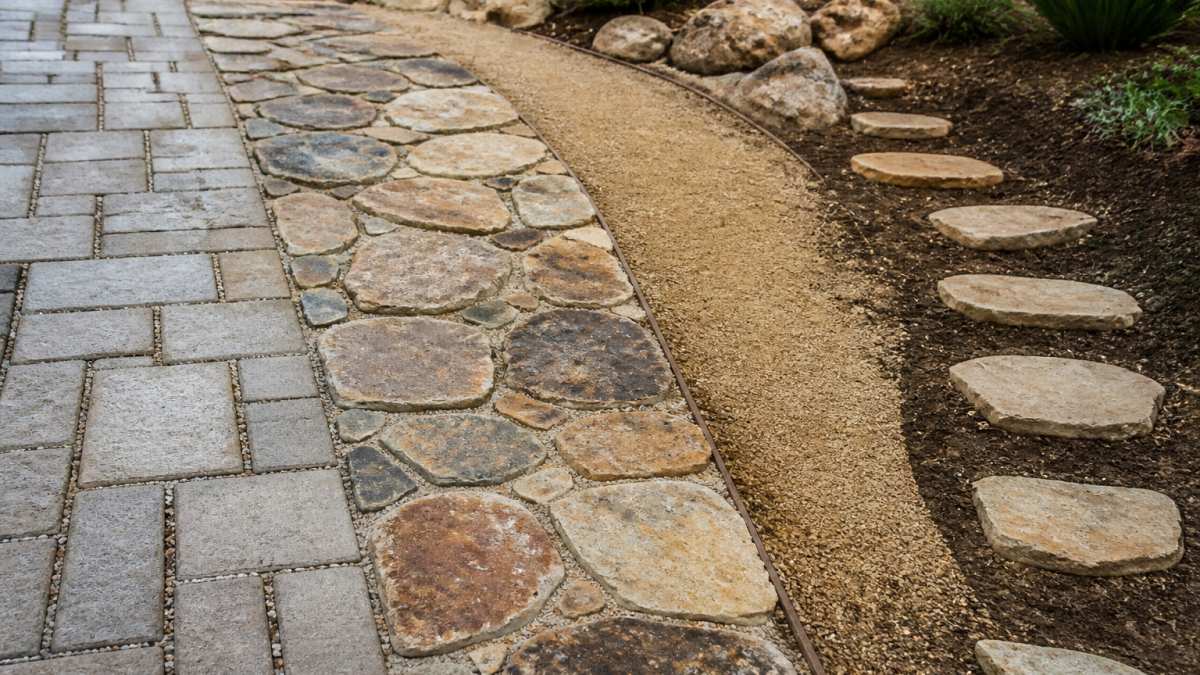
Permeable Pavers and Recycled Concrete
Recycled concrete pavers offer the look of traditional paving at lower cost, made from crushed concrete and aggregate compressed into uniform blocks.
Installation requires a compacted gravel base, landscape fabric to prevent soil migration, and careful edging. The slope becomes an advantage: water flows naturally downhill through the permeable surface.
Slope-specific performance: Open-joint pavers with a 1/8- to 3/8-inch gap and a chamfered edge give the best wet traction because water drains before it can sheet across the face.
Flagstone and Natural Stone
Flagstone is durable, beautiful, and naturally slip-resistant when properly sealed.
Flagstone costs more than gravel or recycled concrete but lasts 20 to 30 years with minimal maintenance. Sealing every two to three years protects it from weathering and keeps it slip-resistant when wet.
Slope-specific performance: Flagstone's advantage on a slope is mass. A 1.5- to 2-inch-thick stone on a compacted base resists being pushed downhill far better than a thin paver.
Above about 15 percent, flagstone is usually installed as individual steps rather than a continuous ramp.
Stepping Stones and Large Rocks
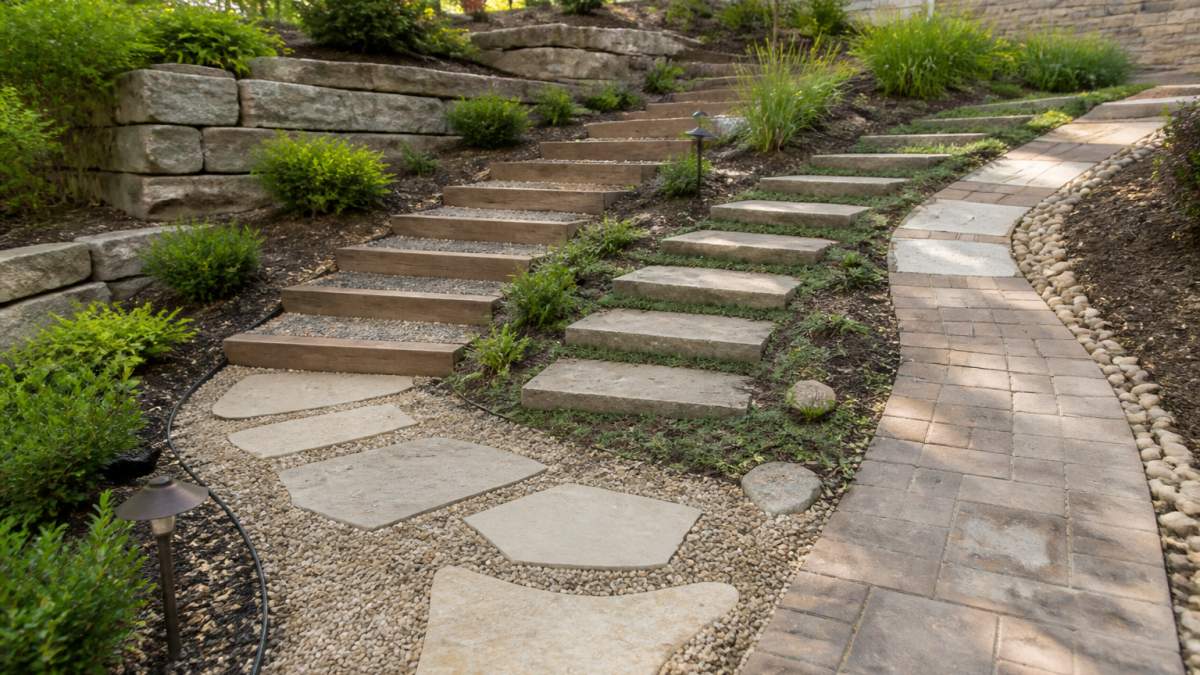
Stepping stones work well on steeper slopes where a continuous walkway isn't practical.
Large rocks or boulders can be positioned as steps up a slope.
The downside is maintenance: soil shifts between stones, weeds grow in the gaps, and you may need to reset stones after heavy rain or freeze-thaw.
Embed each stone so its top sits 1/2 to 1 inch above the surrounding soil, too high is a trip hazard, too low and soil washes over the face.
Mulch and Wood-Chip Paths
Mulch and wood chips are the least expensive and easiest to install, which is why they appear in nearly every list of concrete alternatives.
A loose wood-chip path above about 5 percent will migrate downhill with every heavy rain unless contained.
Slope-specific performance: Wood chips and bark mulch are best treated as a temporary or low-traffic solution on slopes.
The upside is cost and permeability: a chip path sheds water almost completely and rarely contributes to erosion as long as it's edged.
Gravel Path on a Slope: Installation and Maintenance
The key is a solid foundation: landscape fabric pinned to the slope, 3 to 4 inches of coarse gravel, then 2 to 3 inches of decomposed granite or pea gravel on top.
Maintenance means raking every few months to redistribute migrated gravel and adding fresh material after heavy rain. In freeze-thaw areas, gravel can heave and shift significantly.
Decomposed granite (DG) is a step up from loose gravel: it compacts more firmly, migrates less readily, and stays permeable for excellent drainage.
Paver Walkway on a Slope: Design and Stability
A paver walkway on a slope requires more planning than a flat installation, but the result is a stable, attractive surface that handles water and foot traffic well.
Start with the base: a 4-inch compacted gravel minimum, plus landscape fabric to prevent soil migration.
Edging is critical: use metal, stone, or concrete along the downhill side to prevent pavers creeping downhill over time.
Slope-specific design means channeling water off the surface.
Maintenance is straightforward: sweep, occasionally power-wash, and reapply sand to joints if they settle. On a properly installed slope, pavers last 15 to 20 years or longer.
How to Prevent Walkway Erosion on a Slope
Erosion is the enemy of any sloped walkway. Water running downhill carries soil with it, destabilizing the walkway and creating gullies on either side.
First, direct water away from the walkway.
Second, use permeable materials that let water pass through rather than running off.
Third, stabilize the slope itself. Ground cover, native grasses, sedges, or low shrubs hold soil in place; on a steep slope, a retaining wall anchors the upper section and reduces the grade.
Fourth, install proper edging and base preparation. A compacted base with landscape fabric prevents soil migration.
Finally, maintain your walkway: remove debris that blocks drainage, rake gravel paths to redistribute material, and repair small damage before it becomes major.
Material Comparison: Cost, Durability, and Maintenance
Choosing the right concrete walkway alternative means balancing upfront cost, lifespan, and ongoing maintenance.
| Material | Lifespan | Maintenance Frequency | Best For | Slope Limit |
|---|---|---|---|---|
| Gravel | 3-5 years | Every few months | Budget-conscious, gentle slopes | 10% |
| Decomposed Granite | 5-7 years | Annually | Moderate slopes, natural look | 15% |
| Stepping Stones | 10-15 years | As needed | Steep slopes, minimal impact | 25%+ |
| Recycled Pavers | 15-20 years | Every 2-3 years | Moderate budgets, permeable surface | 15% |
| Flagstone | 20-30 years | Every 2-3 years | High-traffic areas, premium look | 15% |
| Permeable Pavers | 15-25 years | Every 2-3 years | Drainage-critical areas, long-term value | 20% |
Gravel is cheapest upfront but demands ongoing maintenance. Decomposed granite costs a bit more but holds up better. Pavers and stone cost significantly more initially but last decades with minimal care. On a sloped yard, that longer lifespan often justifies the higher cost, since you won't be replacing the walkway every few years.
Choosing the Right Walkway for Your Sloped Yard
The slope itself is your primary constraint, but grade alone doesn't determine the right material. Accessibility, drainage, soil, and how the path will be used matter just as much. Here are the decisions in the order most installers make them.
Start With the Grade, Not the Material
Measure vertical rise over horizontal run and convert to a percentage: a 10-foot run rising 1 foot is a 10 percent grade. Most residential sloped yards fall between 5 and 30 percent, and options narrow quickly as the number climbs.
- Under 5 percent: Effectively flat. Any material works, including standard concrete.
- 5 to 10 percent: Gravel, decomposed granite, pavers, flagstone, and stepping stones all perform well. This is the widest range of options.
- 10 to 20 percent: Gravel becomes risky without aggressive edging. Pavers, flagstone, and decomposed granite are the reliable choices. Steps may be more comfortable than a ramp.
- 20 to 30 percent: Continuous surfaces need retaining or terracing. Stepping stones and large rocks become practical. Handrails are strongly recommended.
- Above 30 percent: Treat the path as a staircase, not a walkway. Individual steps with proper risers and treads are the only safe approach.
Accessibility and Safe Dimensions
If anyone in the household uses a walker, wheelchair, or has balance concerns, the constraints change.
For steps, the comfortable range for most adults is a riser of 4 to 7 inches and a tread depth of at least 11 inches, with 12 to 14 inches more comfortable outdoors where footwear varies.
Handrails matter more than most homeowners expect. On any outdoor path above about 20 percent grade, or with three or more risers, a handrail on at least one side is a reasonable safety addition; on a path exposed to rain, snow, or freeze-thaw, both sides is better.
Match the Material to the Site, Not Just the Slope
Two yards with the same grade can call for completely different materials depending on soil, water, and exposure.
Rainfall and runoff. With frequent heavy rain, permeable surfaces and an uphill swale are close to mandatory.
Shade and organic debris. A shaded slope under trees accumulates leaves and needles that clog permeable paver joints and decompose into a slick layer on stone.
Foot traffic. A path used daily by a family and a dog needs a more stable surface than an occasional decorative path.
Budget and Total Cost of Ownership
Upfront cost is only part of the picture: a cheap gravel path topped off yearly and replaced every few years can cost more over two decades than a paver path installed once. Estimate installed cost, annual maintenance, and expected lifespan, then divide total cost by years of service.
Gravel and chips are lowest upfront and highest ongoing. Decomposed granite sits in the middle. Pavers and flagstone cost the most upfront and the least per year over their lifespan.
When to Bring In a Professional
Some sloped walkway projects are weekend DIY jobs. Others are not. The line usually falls at three points:
- Grade above 20 percent. Terracing, retaining, and step geometry get complicated fast, and a mistake shows up as a path that slides or a step that trips.
- Water problems. If water already runs across the slope during storms, or if the soil stays saturated, drainage has to be solved before any surface goes down. A path installed over a drainage problem will fail regardless of material.
- Accessibility requirements. If the path needs to meet specific dimensional standards for a household member, the design work is worth paying for.
Moises Pizana Hardscapes specializes in crafting functional outdoor living spaces, including walkways. We understand how each material performs on your terrain, what drainage challenges exist, and how to design a walkway that lasts. A professional assessment of your slope, grade, soil type, water flow, and exposure, guides the right material choice.
Frequently Asked Questions
What is the best material for a walkway on a slope?
The best material depends on your slope grade and maintenance tolerance. Permeable pavers and flagstone offer stability and durability on moderate slopes. Gravel is affordable but requires regular maintenance to prevent washing away. Stepping stones work well for steeper slopes where a continuous path isn't needed. Decomposed granite provides a natural look with moderate slip resistance. For slopes steeper than 1:3 (33%), consider pavers with proper edging and base preparation, or consult a professional to assess drainage and erosion risks.
How do you keep gravel from washing away on a sloped path?
Proper base preparation is critical. Install a geotextile membrane under the gravel to prevent washout while allowing drainage. Use larger aggregate (3/4-inch or larger) rather than fine gravel, which washes away faster. Create subtle berms or edge restraints along the sides to contain material. On steep slopes, consider mixing gravel with a stabilizer product or using decomposed granite, which compacts better. Install drainage channels above the path to divert water runoff away from the walkway surface.
Are pavers or natural stone better for a sloped walkway?
Pavers offer consistent sizing, easier installation, and better interlocking stability on slopes. Recycled concrete pavers provide excellent traction and durability. Natural stone (flagstone) offers aesthetic appeal and excellent slip resistance but requires careful leveling on slopes and can be more labor-intensive to install. Pavers generally perform better on moderate slopes (1:4 to 1:6 grade) because their uniform size allows for secure base preparation. Natural stone excels on gentler slopes or as accent pieces. Choose based on your slope severity, budget, and desired appearance.
How can you make a sloped yard path safer to walk on?
Select materials with high slip resistance: flagstone, textured pavers, or decomposed granite outperform smooth concrete. Install edging or low retaining walls to prevent stepping off the path. Ensure proper drainage to avoid standing water and ice formation. Space stepping stones at comfortable intervals (24 to 30 inches apart). Add subtle handrails or rope guides on steep sections. Maintain consistent step heights if you're installing stairs. Keep the surface clear of debris and moss growth, which reduces traction. Professional installation ensures proper base compaction and slope-appropriate grading.