 listicle
Alternatives to Traditional Concrete Retaining Walls
Table of Contents
- Why Homeowners Choose Alternatives to Traditional Concrete Retaining Walls
- Natural Stone and Boulder Walls
- Segmental Retaining Wall Blocks
- Timber vs Concrete Retaining Walls
- Gabion Wall Construction and Drainage
- Eco-Friendly and Permeable Materials
- Comparison Table: Material Performance and Durability
- Permitting and Building Code Requirements
- Frequently Asked Questions
Last Updated: September 29, 2026
Why Homeowners Choose Alternatives to Traditional Concrete Retaining Walls
Concrete retaining walls have dominated backyard landscaping for decades. They're functional, durable, and straightforward to build. But they're not always the best choice.
Homeowners increasingly seek alternatives to traditional concrete retaining walls because concrete cracks, requires expensive repairs, looks industrial, and drains poorly, creating hydrostatic pressure that weakens structures over time. At Moises Pizana Hardscapes, we help Dallas-Fort Worth property owners find solutions combining durability, aesthetics, and long-term value.
The right retaining wall depends on soil type, slope angle, budget, and landscape fit. Some alternatives cost less upfront; others require less maintenance or offer environmental benefits concrete cannot match.
Natural Stone and Boulder Walls
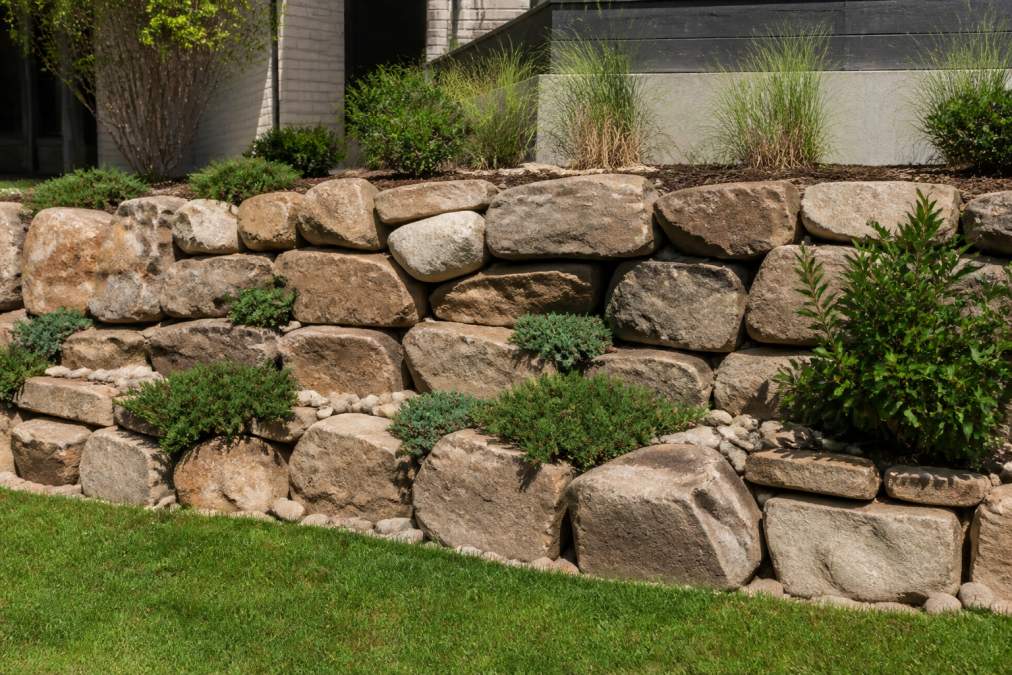
Natural stone and boulders create a timeless, high-end appearance that blends seamlessly into landscapes. Large boulders stacked without mortar allow water to drain naturally, preventing the hydrostatic pressure buildup that causes concrete walls to fail. Each wall is unique.
Installation is labor-intensive, requiring skilled crews to create stable, visually balanced structures. Cost depends on stone availability and wall height; local sourcing reduces transportation expenses.
Natural stone walls work best for slopes under 8 feet tall and in areas where local stone is readily available. For very tall walls or steep grades, you'll need geogrid reinforcement or professional engineering. The stone itself lasts indefinitely, but mortar joints (if used) may need repointing every 15-20 years.
Segmental Retaining Wall Blocks
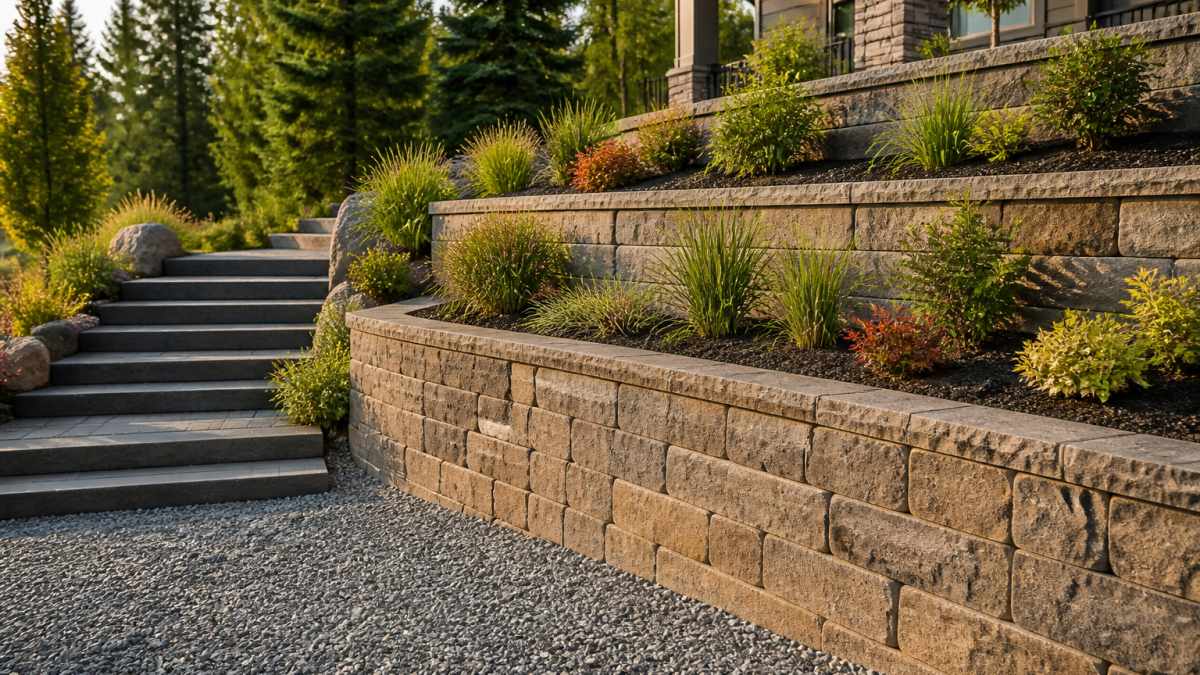
Segmental blocks are modular, manufactured units (Keystone, Techo-Bloc) that interlock without mortar. They come in colors and textures mimicking natural stone and provide structural stability without concrete. Installation is straightforward: stack, add geogrid for taller walls, and backfill with compacted soil.
Segmental blocks work well for walls 4-12 feet tall; heights above 12 feet require professional engineering. Blocks last 50+ years, though freeze-thaw cycles can cause minor shifts. Cost is less than poured concrete but more than timber; the modular design allows curves, corners, and tiered configurations.
Timber vs Concrete Retaining Walls
Wood retaining walls offer warmth and rustic character, install faster, and are more forgiving during construction. However, timber deteriorates over time, especially in wet conditions, with performance varying by soil type and climate.
Material Lifespan and Soil Interaction
Untreated wood lasts 5-10 years; pressure-treated lumber extends lifespan to 15-20 years. In clay-heavy soils, rot accelerates due to constant moisture. Sandy soils drain faster, extending service life. Rocky soils with good permeability are ideal. High water tables or seasonal flooding can cause failure within 10-12 years.
Composite materials (recycled plastic and wood fiber) last 25-30 years without rotting, regardless of soil type. They cost 40-60% more upfront than pressure-treated lumber but require virtually no maintenance and perform consistently in wet or clay-based soils.
Frost Heave and Freeze-Thaw Cycles
In freeze-thaw regions, soil moisture expands when frozen, pushing walls outward (frost heave). Timber walls shift and lean permanently. Timber works best for walls under 6 feet in cold climates. In areas with 20+ freeze-thaw cycles per winter, timber walls typically require re-leveling or replacement within 12-15 years.
Lifecycle Cost Comparison
A 4-foot timber wall (20 feet long) costs $1,200-$2,000 to install; over 20 years with one replacement, total cost is $2,400-$4,000. A segmental block wall costs $2,500-$4,000 upfront and lasts 50+ years. A concrete wall costs $3,000-$5,000 upfront but requires crack repairs ($500-$2,000 each) every 8-12 years, totaling $4,000-$7,000 over 20 years.
Timber is cheapest upfront but most expensive over time in cold, wet climates. In dry climates with minimal freeze-thaw, timber becomes competitive on lifecycle cost.
Drainage and Soil Saturation
Both timber and concrete walls need proper drainage to prevent soil saturation. Saturated soil increases lateral pressure, accelerating rot and cracking. A timber wall in clay soil without drainage fabric and perforated drain pipe will fail faster than the same wall in sandy soil with proper drainage. The drainage system often determines lifespan more than wood quality.
Timber works best for walls under 6 feet in dry climates or sandy soils. In wet climates, clay soils, or freeze-thaw zones, composite materials or segmental blocks provide better long-term value.
Gabion Wall Construction and Drainage
Gabion baskets are wire mesh containers filled with stone that create permeable structures excelling at drainage and erosion control. Water passes freely through the fill, eliminating hydrostatic pressure. The flexible structure adapts to minor ground movement without cracking.
Installation requires manual labor to fill baskets. Gabion walls cost less than segmental blocks but more than timber. Local stone sourcing reduces transportation costs. Wire mesh may rust over time; galvanized or PVC-coated options extend lifespan.
Gabions work well for walls 4-10 feet tall. They're particularly effective for curved designs and naturalistic landscapes. The industrial appearance appeals to modern designs but may not suit traditional residential settings. Maintenance is minimal, occasionally check for settling and add stone if needed.
Eco-Friendly and Permeable Materials
Environmental concerns drive homeowners toward sustainable alternatives to traditional concrete retaining walls. Recycled materials, fly ash concrete, and soil blocks reduce carbon footprint. However, eco-friendly doesn't always mean durable; performance depends on soil type and climate.
Fly Ash Concrete and AshCrete Blocks
AshCrete replaces 20-40% of Portland cement with recycled fly ash, reducing embodied carbon by 25-35% while maintaining equivalent compressive strength. However, fly ash concrete has the same drainage problem as traditional concrete, water cannot permeate, so hydrostatic pressure builds. In clay soils, fly ash walls crack at the same rate as concrete. Fly ash blocks work best for walls under 6 feet in dry climates with excellent drainage infrastructure. In wet climates or clay soils, segmental blocks provide better long-term value.
Compressed Stabilized Earth Blocks (CSEB)
CSEB blocks are made from on-site soil mixed with a small amount of stabilizer (typically 5-10% Portland cement or lime) and compressed into blocks. They offer extremely low environmental impact because the material is sourced locally and requires minimal processing. A typical CSEB wall produces 80-90% less embodied carbon than concrete.
However, CSEB performance is highly soil-dependent. These blocks work well in clay soils because the clay provides structural cohesion. In sandy soils, CSEB blocks are unstable and prone to crumbling.
Recycled Plastic and Composite Alternatives
Soil Type Compatibility Matrix
| Material | Clay Soils | Sandy Soils | Rocky Soils | Wet Climates | Freeze-Thaw Zones |
|---|---|---|---|---|---|
| Fly Ash Concrete | Fair (needs drainage) | Good | Good | Poor | Fair |
| CSEB Blocks | Excellent | Poor | Poor | Poor | Fair |
| Recycled Plastic | Excellent | Excellent | Excellent | Excellent | Excellent |
| Natural Stone | Good | Excellent | Excellent | Good | Good |
| Segmental Blocks | Good | Good | Good | Good | Good |
Making the Right Choice
Comparison Table: Material Performance and Durability
| Material | Lifespan | Best Height | Drainage | Maintenance | Aesthetic |
|---|---|---|---|---|---|
| Natural Stone | 50+ years | 4-8 feet | Excellent | Minimal | High-end |
| Segmental Blocks | 50+ years | 4-12 feet | Good | Minimal | Modern |
| Timber (treated) | 15-20 years | 3-6 feet | Fair | Moderate | Rustic |
| Composite Wood | 25-30 years | 3-6 feet | Fair | Minimal | Rustic |
| Gabion Baskets | 20-40 years | 4-10 feet | Excellent | Minimal | Industrial |
| Poured Concrete | 40-50 years | 6-20 feet | Poor | High | Industrial |
| AshCrete | 40-50 years | 6-15 feet | Poor | High | Industrial |
| CSEB Blocks | 15-25 years | 3-6 feet | Fair | Moderate | Natural |
Permitting and Building Code Requirements
Most jurisdictions require permits for retaining walls over 4 feet tall. Some areas regulate walls over 3 feet. Check with your local building department before starting any project.
Frequently Asked Questions
What is the cheapest alternative to a concrete retaining wall?
Gabion baskets and compressed stabilized earth blocks offer the lowest material costs for retaining wall alternatives. Gabions use locally sourced stone in wire mesh containers, reducing material expenses. However, labor intensity varies by system. For an accurate cost comparison for your specific project, contact Moises Pizana Hardscapes for a detailed quote based on your slope, height, and soil conditions.
Are natural stone walls better than concrete retaining walls?
Natural stone walls offer superior aesthetics and durability compared to poured concrete, with minimal maintenance and excellent weather resistance. They provide unique, non-uniform appearances that enhance landscape design. However, natural stone requires higher labor costs for placement and fitting. The choice depends on your budget, aesthetic preferences, and whether you prioritize appearance or cost-efficiency. Professional installation ensures proper structural integrity.
Do I need a permit for a non-concrete retaining wall?
Yes, most jurisdictions require permits for retaining walls regardless of material, especially those exceeding 4 feet in height or affecting drainage. Building codes vary by location and may specify engineering requirements, setback distances, and drainage specifications. Before starting any retaining wall project, check with your local building department. Moises Pizana Hardscapes handles permit coordination and ensures compliance with all applicable codes.
What are the most durable materials for a retaining wall?
Natural stone boulders and large-format precast blocks like Redi-Rock offer the highest durability, lasting 50+ years with minimal maintenance. Segmental blocks with geogrid reinforcement provide excellent longevity for residential applications. Timber walls require regular maintenance and typically last 10-20 years. Material selection depends on your climate, soil type, and long-term maintenance commitment. Professional design ensures your chosen material performs optimally in your specific conditions.
How do gabion walls compare to traditional concrete for erosion control?
Gabion walls excel at erosion control due to their permeable design, which prevents hydrostatic pressure buildup and allows water to drain freely through the stone fill. Traditional concrete walls can trap water behind them, potentially causing failure. Gabions also adapt to minor ground movement without cracking. For slopes with significant water flow or drainage concerns, gabions provide superior performance. Their flexibility and permeability make them ideal for erosion-prone landscapes.