 How-to
How to Plan Sustainable Backyard Irrigation Systems
Last Updated: November 6, 2026
Quick Summary
Sustainable backyard irrigation for Texas homes means delivering water low, slow, and only where roots can drink it, using rotary nozzles, drip lines, and smart controllers instead of wasteful fixed sprays. Cycle-and-soak watering in short bursts lets clay soil absorb each round rather than sheeting off. Pair these methods with rainwater harvesting and an annual spring audit to catch leaks and reset schedules.
- Rotary nozzles throw water in a slow rotating stream, giving soil time to absorb it.
- Bury drip lines a few centimeters under mulch, not deep in the soil.
- Water in the early morning before sunrise to cut wind drift and evaporation.
- Run an annual irrigation audit each spring before the heat arrives.
- Sandy soil drains fast and needs shorter, more frequent cycles than clay.
Table of Contents
- Water-Efficient Irrigation Methods That Work in Texas Heat
- Drip Irrigation for Texas Landscapes: Targeted Watering That Saves
- Smart Irrigation Controllers and Weather-Based Scheduling
- Rainwater Harvesting for Backyard Irrigation: Barrels, Cisterns, and Gutters
- Irrigation System Maintenance and Leak Detection: The Annual Audit
- Matching Watering Schedules to Soil, Zones, and Plant Needs
- Planning Your Irrigation Project: Equipment, Costs, and DIY vs Pro
- Get a Quote for a Yard That Handles Water Right
- Frequently Asked Questions
Water-Efficient Irrigation Methods That Work in Texas Heat
Sustainable backyard irrigation systems for Texas homes start with one hard truth: most of the water you spray into the air never reaches a plant root. It evaporates, runs down the curb, or soaks into soil that can't hold it. This guide from Moises Pizana Hardscapes walks through the methods that actually work here, from rotors and drip lines to smart controllers and rainwater capture.
The goal is simple. Deliver water low, slow, and only where roots can drink it.
Sprinkler System Efficiency: Rotors, Spray Heads, and What to Skip
Rotary nozzles are generally considered efficient for lawn coverage. They throw water in a slow, rotating stream, which gives soil time to absorb it. Fixed spray heads dump water fast and can lose a good deal of it to wind and evaporation.
Skip the cheap oscillating sprinklers on a hose. They water unevenly and lose a large share to the air before it lands.
- Rotors: best for large lawn areas, slower application
- Fixed sprays: fine for small, flat zones, wasteful on slopes
- Impact sprinklers: durable but uneven, better for rural lots
Cycle-and-Soak Watering to Beat Runoff and Evaporation
Cycle-and-soak is an effective way to reduce runoff. Instead of running a zone for 20 minutes straight, you run it in short bursts with pauses between.
On clay-heavy soil, water often runs off after a few minutes. Short cycles let it sink in.
For yards that shed water across hard surfaces, permeable walkway installation pairs well with smarter watering. Both reduce how much water leaves your yard as runoff.
Drip Irrigation for Texas Landscapes: Targeted Watering That Saves
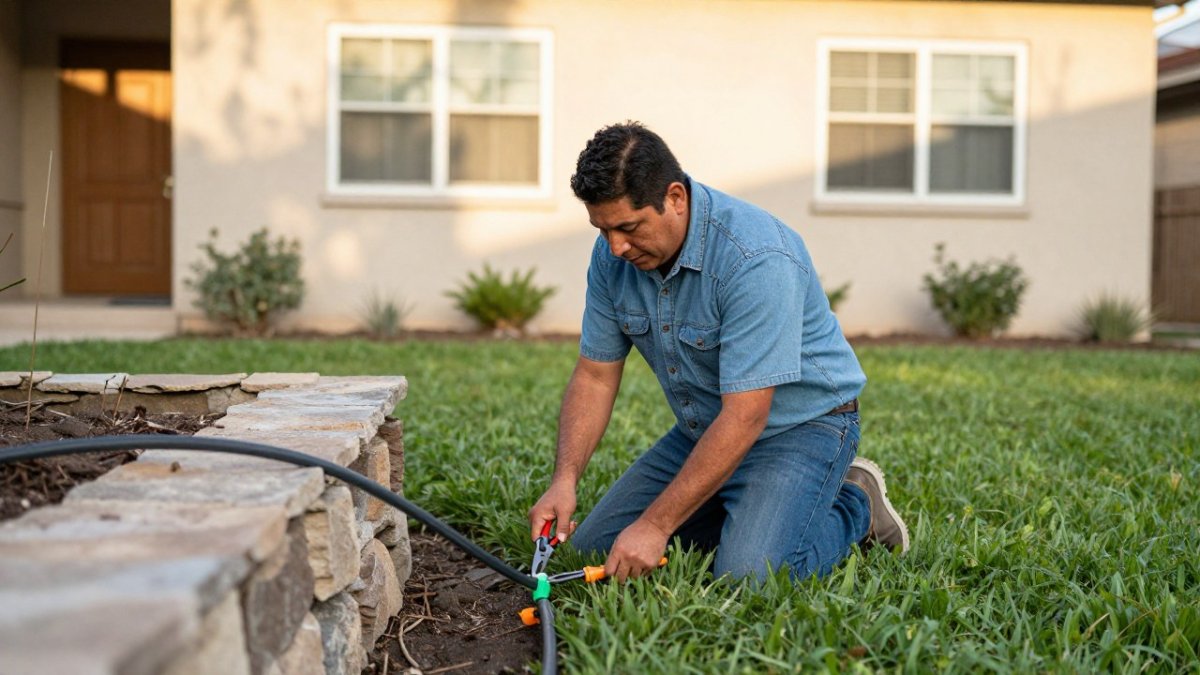
Drip irrigation for Texas landscapes delivers water straight to the root zone through low-flow emitters, which limits losses to wind and evaporation.
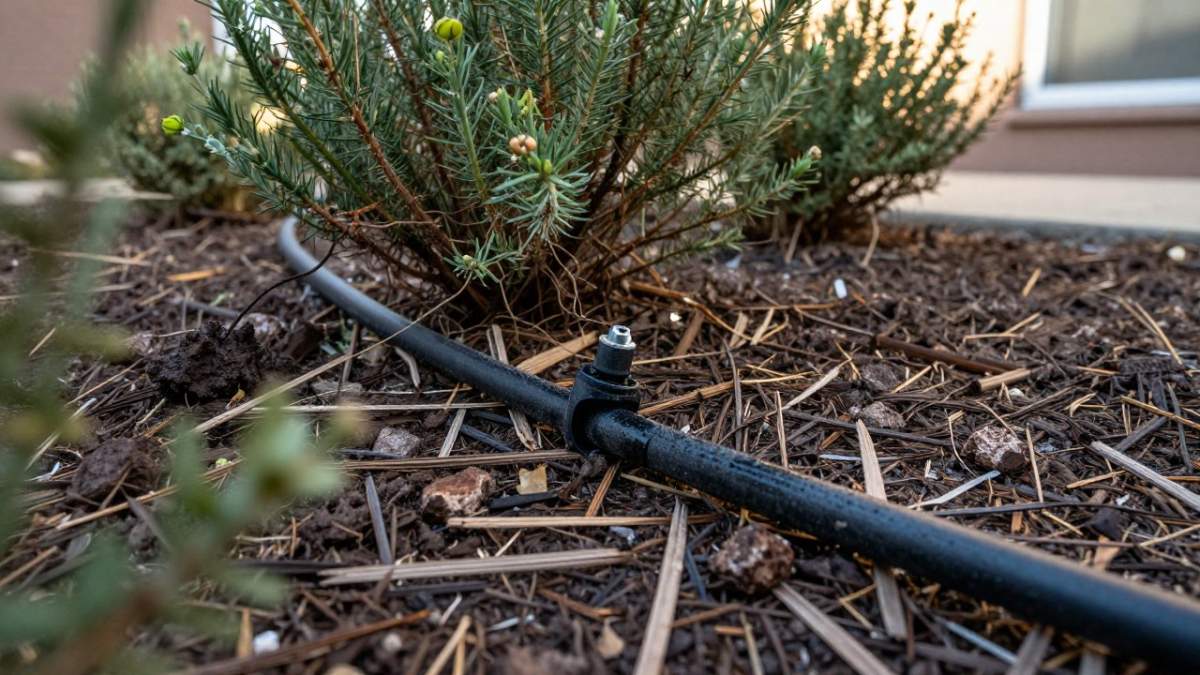
A common mistake is running drip lines too shallow. Bury them a few centimeters under mulch, not deep in the soil. Roots gather where the water lands, so placement matters.
- Best for: garden beds, trees, shrubs, vegetable plots
- Worst for: large open lawns
- Watch out: clogged emitters from dirty water, so add a filter
Smart Irrigation Controllers and Weather-Based Scheduling
Smart irrigation controllers can adjust watering based on local weather and soil moisture, skipping cycles when rain is forecast and shortening runtimes on cool days.
The old advice was to set a timer and forget it. That's how yards get soaked in spring and starved in August. A weather-based controller resets itself as conditions change.
How Weather-Based Scheduling Actually Works
A smart controller pulls local evapotranspiration (ET) data, the combined water loss from soil evaporation and plant transpiration, from a weather service or an on-site sensor. Because these zone-specific inputs make it easier to match watering to actual landscape needs, the same water-efficient irrigation design principles can guide planning across new housing estates.
Two common control types:
- ET-based controllers use local weather data to calculate runtimes. They work well in areas with reliable weather stations nearby.
- Soil-moisture-sensor controllers read actual moisture at the root zone and water only when it drops below a threshold. They cost more but respond to real conditions rather than estimates.
Look for controllers that support multiple programs and zone control. Pair them with a rain sensor for a cheap backup, a rain sensor shuts off a cycle when it detects a set amount of rainfall, even if the controller's weather data is stale.
Setting Up Zones and Schedules Step by Step
- Map your zones. Group plants by water need and sun exposure, full-sun lawn, shaded beds, vegetable plots, and newly planted shrubs should not share a schedule.
- Enter zone details. For each zone, input soil type (sand, loam, clay), plant type, slope, and emitter type (rotor, spray, drip). These inputs drive the controller's runtime calculation.
- Set a start time. Water in the early morning, before sunrise, to cut wind drift and evaporation. Avoid evening watering, which keeps foliage wet overnight and invites disease.
- Enable cycle-and-soak. Most smart controllers have a cycle-and-soak setting that splits a zone's runtime into short bursts with pauses, essential on clay soil and slopes.
- Set a rain delay and freeze shutoff. A rain sensor or the controller's weather feed should pause watering after meaningful rainfall. A freeze shutoff protects lines and prevents ice on walkways.
- Review after two weeks. Check the controller's water-use history and adjust runtimes if zones are staying soggy or drying out too fast.
Adjusting for Seasons, Drought, and Extreme Heat
Treat the schedule as a starting point, not a fixed calendar. In spring, when soil is cool and rainfall is common, most controllers can run at a low seasonal-adjust percentage.
During drought or when a municipal utility issues watering restrictions, use the controller's program-override or water-budget feature to cut total outdoor use while keeping the most valuable plants alive.
Watch out: a smart controller is only as good as its inputs.
What to Look For in a Controller
- Zone count that matches or exceeds your current zones, with room to add
- Weather source, local ET data or an on-site sensor
- Cycle-and-soak support
If you already have a working timer and valve system, a smart controller is often a direct swap at the controller box, one of the lowest-effort efficiency upgrades available.
Rainwater Harvesting for Backyard Irrigation: Barrels, Cisterns, and Gutters
Rainwater harvesting for backyard irrigation captures roof runoff in barrels or cisterns and reuses it on the landscape.
Route gutter water into your storage, then connect a drip line or soaker hose to the outlet. Keep barrels screened to block mosquitoes.
If your downspouts dump water too close to the house, extend downspouts away from the foundation first. Then redirect that flow into your harvesting setup.
- Rain barrels: cheap, small volume, good for beds
- Cisterns: larger storage, better for whole-yard use
- Gutters: the collection point, keep them clear
Irrigation System Maintenance and Leak Detection: The Annual Audit
Irrigation system maintenance and leak detection protect both your water bill and your plants.
Walk each zone and look for geysers, soggy spots, and tilted heads. A broken head can waste water for weeks before you notice.
- Inspect every sprinkler head for damage
- Look for pooling water or sunken soil
- Test the rain sensor
Watch out: a slow leak under a patio or walkway can undermine the base. If you see settling pavers, have them looked at early.
Matching Watering Schedules to Soil, Zones, and Plant Needs
Watering schedules should match your soil, your zones, and your plants, not a fixed calendar. Sandy soil drains fast and needs shorter, more frequent cycles.
Split your yard into zones by plant type and sun exposure. Lawn, beds, and shade areas have different needs.
On sloped yards, runoff carries water and soil downhill. If erosion is a concern, preventing erosion on a sloped backyard explains how grade and drainage shape where water ends up.
Deep, infrequent watering generally encourages deeper root growth than light daily sprinkling. Let the top layer dry between cycles.
Planning Your Irrigation Project: Equipment, Costs, and DIY vs Pro
Planning comes down to three questions: what you'll install, what it costs, and who does the work. A drip system for beds is a weekend DIY job. A full sprinkler system with trenching and wiring is usually a pro project.
Equipment List by Project Type
DIY drip kit for beds and shrubs
- 1/2-inch polyethylene drip tubing (mainline)
- 1/4-inch distribution tubing for individual plants
- Pressure-compensating emitters or inline drip tubing with built-in emitters
Pro-style sprinkler system for a lawn
- Rotor or rotary nozzles for lawn zones
- Pop-up spray heads for small or narrow areas
- PVC or polyethylene pipe, fittings, and primer/cement
Add-ons that pay off
- Rain barrel or cistern with downspout diverter
- Soaker hose for temporary beds
- Soil moisture sensor for the controller
Cost Ranges and What Drives Them
Pricing depends on yard size, zone count, and equipment, and depends on quantity, dates, and delivery. For current prices or a quote, visit the Moises Pizana Hardscapes website. As a general planning guide, the relative cost tiers typically look like this:
- Hose-end timer and soaker hose: lowest cost, best for small beds and renters
- DIY drip kit for a typical bed area: moderate cost, weekend install
- Smart controller add-on to an existing system: low cost, high efficiency gain
Get a written quote rather than guessing. Ask whether the quote includes permits, backflow testing, and a controller, since those items are sometimes separate.
Project Timeline
A DIY drip kit for a few beds can be planned and installed in a weekend. A full sprinkler system typically takes several days to a couple of weeks depending on yard size, trenching, and inspections. Rainwater harvesting adds time for gutter work and barrel or cistern placement.
DIY vs Pro: How to Decide
- DIY is reasonable for drip kits, hose-end timers, rain barrels, and smart-controller swaps on an existing system.
- Pro is usually the right call for new in-ground sprinkler systems, backflow prevention, electrical work at the controller, and any project that requires permits or inspections.
- Hybrid approach: have a designer lay out zones and grading, then install the simple parts yourself.
For a system that ties into patios, walkways, and grading, a designer can plan the whole layout. You can hire a residential hardscape designer to coordinate irrigation with the hardscape.
Design Basics Before You Buy
- Zone by plant need and sun exposure, not by convenience.
- Space emitters and heads to match the manufacturer's spacing chart, closer spacing on slopes and sandy soil, wider on flat loam.
- Keep turf and drip beds on separate valves so each gets the right runtime.
| Approach | Best For | Effort | Notes |
|---|---|---|---|
| Hose-end + timer | Small yards, renters | Low | Cheapest, least efficient |
| DIY drip kit | Beds and shrubs | Medium | Great water savings |
| Pro sprinkler system | Full lawns | High | Trenching, wiring, zones |
| Smart controller add-on | Any existing system | Low | Big efficiency gain |
Get a Quote for a Yard That Handles Water Right
Water that pools against your foundation or streams across a patio is worth addressing as part of your yard's design. At Moises Pizana Hardscapes, we build custom patios, retaining walls, driveways, and walkways.
See our finished work in the project gallery, then get a quote.
A yard that manages water well takes planning, from drip lines to grading to the hardscape around them.
Frequently Asked Questions
Which irrigation system is the most sustainable for a Texas backyard?
Drip irrigation paired with a smart controller is the most sustainable combination for most Texas yards. Drip lines deliver water straight to the root zone, so less is lost to evaporation and wind, and a weather-based controller adjusts runtime as conditions change. Add mulch over the lines and a rain sensor, and you cut outdoor water use further. For lawns, use efficient rotors on separate zones rather than spray heads. Rainwater harvesting can supply part of the demand, especially for beds and containers.
Is drip irrigation a good choice for a Texas backyard?
Yes. Drip irrigation for Texas landscapes suits planting beds, trees, shrubs, vegetable gardens, and containers because it puts water at the roots instead of in the air. It holds up well in heat and wind, and it keeps foliage dry, which lowers disease pressure. Lawns still need sprinklers or subsurface drip designed for turf. Run drip on its own zone with a filter and pressure regulator, and check the lines each season for clogs and damage.
Can rainwater harvesting be used with a backyard irrigation system?
Yes. Rainwater harvesting for backyard irrigation works with a rain barrel or cistern fed by gutter downspouts, then a pump or gravity feed to drip lines or a hose bib. Size the barrel to your roof catchment and typical rainfall. Use a first-flush diverter and screen to keep debris out, and keep the tank covered to limit mosquitoes. Stored water is best used for beds and containers rather than an entire lawn, since supply runs short in dry stretches.
How can I tell if my irrigation system is wasting water?
Watch for runoff running down the curb, water pooling in low spots, misting spray heads, and constantly wet patches that never dry. Compare your water bill across months with similar weather. Run a system audit: walk each zone while it runs, check for broken heads and tilted nozzles, and look for leaks at valves and connections. A smart controller with a rain sensor and cycle-and-soak settings fixes much of the waste once the hardware is sound.