 how-to
How to Prevent Erosion on a Sloped Backyard in DFW
Table of Contents
- Why DFW Slopes Erode Faster Than You Think
- Step 1: Assess Your Slope and Drainage Before You Build
- Step 2: Install Retaining Walls and Terracing to Prevent Erosion
- Step 3: Build Backyard Drainage Solutions That Move Water Away
- Step 4: Choose the Best Ground Cover Plants for Slopes in North Texas
- Step 5: Use Geotextiles, Mulch, and Erosion Control Blankets
- DIY vs. Hiring a Professional: What DFW Homeowners Need to Know
- Seasonal Maintenance Calendar for Erosion Control in DFW
- Frequently Asked Questions
Last Updated: September 25, 2026
Why DFW Slopes Erode Faster Than You Think
North Texas clay soil and sudden heavy rain make slope erosion worse here than in most of the country. To prevent erosion on sloped backyard DFW properties, start by understanding why your yard loses soil so fast. At Moises Pizana Hardscapes, we've built retaining walls and drainage systems across Dallas and Fort Worth.
Clay Soil and Heavy Rain: A Bad Combination
Clay soil is made of tiny, tightly packed particles that swell when wet and shrink when dry, blocking water from soaking in so rain runs off the surface. On a slope, that runoff picks up speed and carries topsoil with it. A common mistake is treating clay like normal dirt: water sits on top for hours, then dumps downhill all at once.
How to Read Your Slope Angle and Water Flow
Walk your yard during the next hard rain and watch where water enters, pools, and exits. That path is your problem line.
- Slope angle: A gentle rise under about 2 feet per 10 feet rarely erodes badly. Steeper than that, and you need a real plan.
- Water flow: Look for ruts, exposed roots, and bare patches. Those mark the channels.
- Soil compaction: Hard, bare clay sheds water instead of absorbing it.
Step 1: Assess Your Slope and Drainage Before You Build
Erosion control starts with a walkthrough, not a shovel:
- Measure your slope angle with a level and a straight board
- Trace where water enters and leaves your yard
- Note bare soil, ruts, and exposed roots
- Check where downspouts dump water
- Confirm your property line and any HOA rules
Many homeowners find their biggest problem isn't the slope itself. It's a downspout pointing the wrong way. Fixing that first can solve half the issue.
Step 2: Install Retaining Walls and Terracing to Prevent Erosion
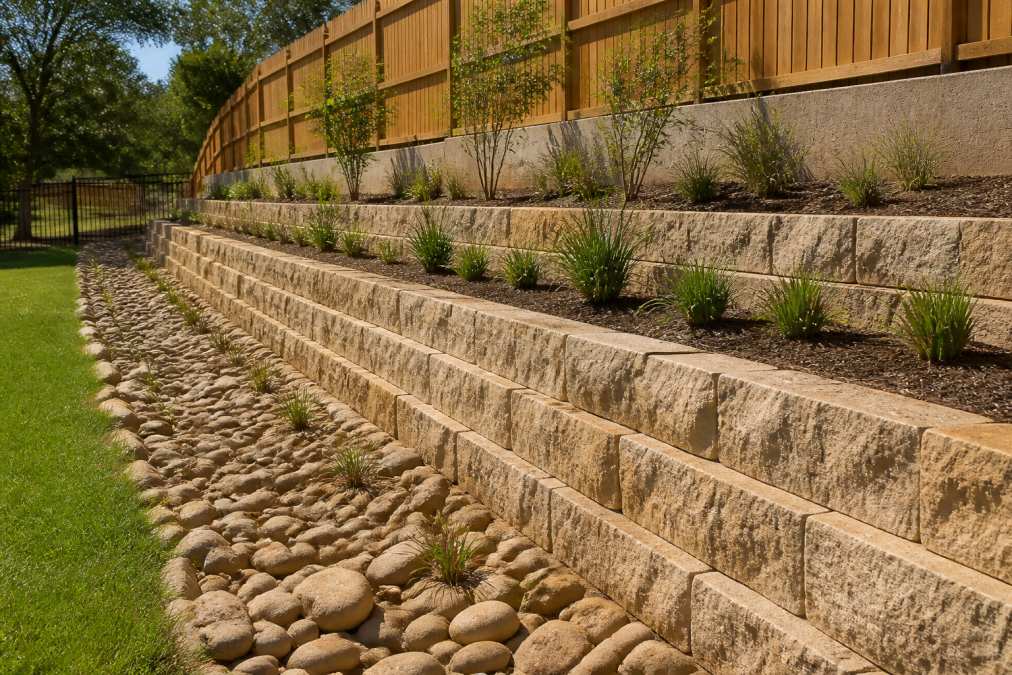
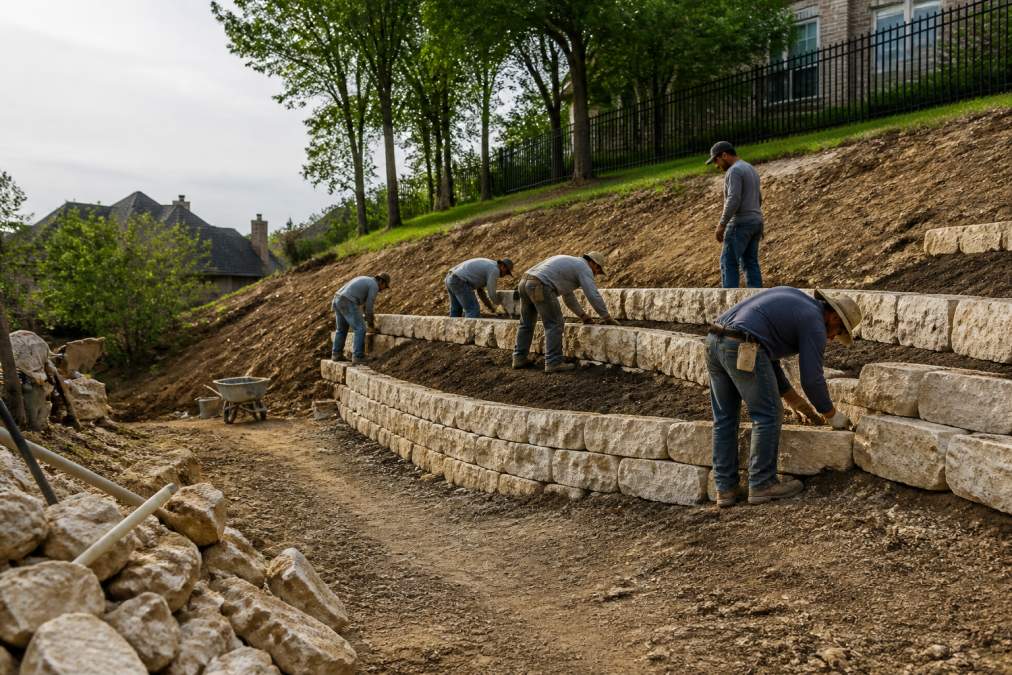
Terracing breaks one long slope into shorter, flatter steps, slowing water so it soaks in instead of running off. A well-built retaining wall holds that shape in place.
Here's what matters most:
- Base depth: The buried base should be roughly 10% of the wall's height for short walls, deeper on tall ones.
- Drainage gravel: Pack gravel behind the wall so water doesn't build up and push it over.
- Weep holes: Small openings let trapped water escape.
- Geotextile fabric: A geotextile fabric layer keeps soil from clogging the gravel.
Retaining Wall Installation Cost: What DFW Homeowners Should Budget For
Retaining wall installation cost depends on height, length, material, grading needs, and access, a short garden wall on flat ground costs far less than a tall engineered wall on a steep slope, and labor rises if a crew can't get equipment to the backyard. For an accurate number, request a site-specific quote.
Step 3: Build Backyard Drainage Solutions That Move Water Away
The best backyard drainage solutions move water off the slope before it can do damage. Three main tools:
- French drains: Buried gravel trenches with a perforated pipe that collect and redirect groundwater.
- Swales: Shallow, grassy channels that guide surface water around your home.
- Surface grading: Reshaping the ground so water flows away from the foundation.
French Drains, Swales, and Surface Water Management
A French drain works best where water pools underground; a swale handles surface runoff and looks natural when planted. Most yards need both. This is surface water management, the step homeowners skip most often.
| Solution | Best For | Watch Out For |
|---|---|---|
| French drain | Underground pooling | Clogging without fabric |
| Swale | Surface runoff | Needs steady slope |
| Grading | Foundation protection | Must drain to a legal exit |
| Downspout extensions | Roof runoff | Too short to matter |
Step 4: Choose the Best Ground Cover Plants for Slopes in North Texas
Plants are the only erosion control method that gets stronger every year. On a sloped North Texas backyard, the goal is a continuous root network that knits the top 6 to 12 inches of clay together so raindrops never hit bare soil.
Why Native Roots Beat Turf on Clay Slopes
Blackland Prairie clay swells when wet and cracks when dry. Shallow turf roots, like a typical St. Augustine lawn, sit in the top 2 to 3 inches and get sheared off as the clay expands and contracts. Native and adapted perennials send roots 6 to 15 feet down, anchoring soil and opening channels that let water infiltrate instead of sheet-flowing downhill.
Ground Covers and Perennials That Actually Hold a Slope
Match the plant to the slope's sun exposure and moisture. Proven North Texas performers:
- Buffalo grass, native, drought-tolerant, 4 to 6 inch roots. Best for sunny, dry upper slopes. Goes dormant in winter but the root mass stays intact.
- Frogfruit (Phyla nodiflora), fast-spreading mat former, tolerates both wet and dry cycles. Excellent for the toe of a slope where water collects.
- Texas sage (Leucophyllum frutescens), woody shrub for hot, exposed faces. Deep taproot, handles reflected heat off walls and pavement.
- Black-eyed Susan (Rudbeckia hirta), self-seeds, 2 to 3 foot roots, fills gaps between shrubs in the first season.
- Inland sea oats, shade-tolerant bunchgrass for north-facing slopes under tree canopy.
- Prairie verbena, low-growing, spreads by seed, good for erosion control on gentle grades.
How to Plant a Slope So It Stays Put
Planting technique matters as much as species choice:
- Plant on contour, not in rows. Stagger plants along the slope's horizontal lines so water has to weave around root crowns instead of running straight down a row gap.
- Space 12 to 18 inches apart for ground covers, wider for shrubs. Bare gaps between plants are where rills start.
- Set plugs, not seed, on slopes steeper than about 3:1. Seed washes off before it germinates; plugs have instant root contact.
- Water deeply and infrequently for the first two growing seasons. Shallow daily watering trains roots to stay near the surface, the opposite of what you want on a slope.
- Mulch 2 to 3 inches around new plants with shredded hardwood or pine straw. Keep mulch off the stems to prevent rot.
What Not to Plant on a DFW Slope
- Bermuda grass, aggressive but shallow-rooted; it holds the surface and nothing below it.
- English ivy, looks dense but forms a shallow mat that peels off clay in sheets during heavy rain.
- Annuals in bare soil, no winter root mass, so the slope sits exposed through the wettest months.
If you want a single rule: choose plants whose roots go deeper than the clay is likely to crack. That eliminates most of what big-box garden centers stock for slopes.
Step 5: Use Geotextiles, Mulch, and Erosion Control Blankets
These fabrics hold soil while plants, walls, and drains do the long-term work. Used wrong, they trap water, kill roots, or wash away in the first storm; used right, they buy the two or three growing seasons it takes for vegetation to take over.
Erosion Control Blankets: The Right Tool for Bare Slopes
An erosion control blanket (ECB) is a woven or netted mat of straw, coconut fiber, or a blend stapled onto bare ground. It absorbs raindrop impact, slows sheet flow, and holds seed and topsoil until roots take over.
Choose by fiber and slope:
- Straw blankets, 6 to 12 month lifespan. Best for gentle slopes under 3:1 and short establishment windows.
- Coconut (coir) blankets, 24 to 36 month lifespan. Use on steep faces, high-flow channels, and anywhere you need protection across two full summers.
- Excelsior (wood fiber) blankets, 12 to 18 months. A middle option for moderate slopes.
- Netting type matters too. Photodegradable netting breaks down after establishment; permanent netting is for channels where the mat itself is structural.
Installation rules that determine whether the blanket works:
- Anchor in a trench at the top of the slope. Bury the leading edge 6 inches deep in a horizontal trench and staple every 12 inches. Blankets that start at the surface peel off in the first big rain.
- Lay blankets vertically down the slope, not horizontally across it. Horizontal seams create dams that channel water underneath.
- Overlap seams 4 to 6 inches and staple through the overlap.
- Staple pattern: 12 inches on center across the mat, 6 inches on center at seams and edges. On steep or sandy soil, tighten to 6 inches throughout.
- No gaps at the blanket edges. Water finds the smallest opening and starts a rill there.
Geotextile Fabric: For Drains, Walls, and Gravel, Not for Surface Slopes
Geotextile fabric is a permeable separator that keeps fine clay particles from migrating into gravel, which clogs French drains and destabilizes retaining wall backfill.
Where it belongs:
- Wrapped around the perforated pipe and gravel in a French drain, non-woven, needle-punched fabric. This is the single biggest factor in whether a drain still works in year five.
- Behind a retaining wall, between the soil and the drainage gravel, keeps clay from silting into the gravel column.
- Under gravel paths, patios, and riprap, prevents the gravel from sinking into soft clay.
Where it does not belong:
- Laid flat on a planted slope as a surface cover. It smothers roots and does not stop sheet erosion the way an ECB does.
- Under mulch in a planting bed. It blocks the soil-to-mulch exchange that earthworms and microbes need.
Mulch: Cheap, Effective, and Easy to Get Wrong on a Slope
Mulch protects bare soil from raindrop impact and holds moisture while plants establish. On a slope, the wrong mulch washes off in the first storm.
- Shredded hardwood or pine straw, interlocking, stays put on grades up to about 3:1. Apply 2 to 3 inches.
- Wood chips, lighter, tend to float off in heavy rain. Use only on gentle grades.
- Hydromulch, sprayed slurry of wood fiber, tackifier, and often seed. The right choice for large bare areas where blankets are impractical. Tackifier is what keeps it on the slope.
- Do not use fresh grass clippings or leaves, they mat, repel water, and smother plants.
Riprap and Permeable Barriers for High-Flow Channels
Where water concentrates, a swale bottom, downspout outlet, or channel between terraces, plants and blankets won't survive the velocity. That's where riprap (graded stone, typically 3 to 12 inches) comes in.
- Set riprap on a geotextile layer, not directly on clay. Without the fabric, the stone sinks and the channel undercuts.
- Size the stone to the flow. Larger stone for steeper, faster channels; smaller stone for gentle outlets.
- Line the channel edges with vegetation to hide the stone and add root reinforcement at the margins.
Hydroseeding: One-Pass Coverage for Large Bare Areas
Hydroseeding sprays seed, mulch, fertilizer, and tackifier in one slurry. It's faster and cheaper than blankets on large, accessible slopes and covers irregular ground mats can't. The trade-off: less mechanical protection, so it's best on slopes under about 3:1 or paired with a light blanket on steeper faces.
DIY vs. Hiring a Professional: What DFW Homeowners Need to Know
Small fixes are fair game for a weekend. Big structural work usually isn't.
- DIY works for: Mulching, planting, downspout extensions, small swales
- Hire a pro for: Retaining walls over 3 feet, terracing, French drains, grading
- Why it matters: A failed wall can cost more to fix than to build right the first time
Seasonal Maintenance Calendar for Erosion Control in DFW
Erosion control isn't one-time; it needs a yearly rhythm.
| Season | Task | Why It Matters |
|---|---|---|
| Spring | Inspect walls and drains | Catch winter damage early |
| Summer | Refresh mulch, check plants | Protect soil in heat |
| Fall | Clear drains, reseed bare spots | Prep for heavy rain |
| Winter | Watch for freeze cracks | Prevent spring failure |
Check weep holes and drain outlets after every big storm. Clear debris before it clogs the pipe. Small habits prevent big repairs.
Frequently Asked Questions
How to keep a sloped yard from eroding?
Start by assessing where water flows and how steep the slope is. Then combine three strategies: terracing or retaining walls to break up the grade, drainage solutions like French drains or swales to redirect water, and deep-rooted ground cover to hold topsoil in place. In DFW, clay soil sheds water quickly, so drainage matters as much as planting. Geotextile fabric under mulch or gravel adds another layer of protection on steeper sections.
How much does it cost to install a retaining wall for erosion control?
Retaining wall installation cost depends on wall height, length, material (block, stone, or timber), and site access. A short garden wall costs far less than a structural wall over 3 feet tall, which may require engineering and permits. Pricing also varies by soil conditions and drainage requirements. Moises Pizana Hardscapes provides custom quotes based on your specific slope, so request a quote for accurate numbers.
What are the most effective erosion control methods for clay-heavy soil?
Clay soil absorbs water slowly and becomes unstable when saturated. The most effective methods combine drainage diversion (French drains, swales, and surface grading), structural support (retaining walls and terraces), and vegetation with deep root systems. Erosion control blankets and geotextile fabric help stabilize bare soil while plants establish. Mulching heavily and avoiding soil compaction during construction also protect clay structure.
Do I need a professional to fix backyard erosion?
Small surface erosion on a gentle slope can often be managed with planting and mulching. But if you see exposed roots, sinkholes, foundation cracks, or water pooling near your home, call a professional. Structural fixes like retaining walls over 3 feet, extensive regrading, or complex drainage systems require equipment and experience. A professional assessment prevents costly mistakes and ensures the fix actually holds.
Erosion on a sloped yard rarely fixes itself. It gets worse with every storm until a wall fails or a foundation cracks. Moises Pizana Hardscapes builds retaining walls, terracing, and drainage systems designed for North Texas clay and rain, with our own crew and equipment on every job. Get a quote and protect your slope before the next storm season.