 how-to
How to Add a Fireplace to Your Outdoor Kitchen Design
Last Updated: November 4, 2026
Quick Summary
To learn how to add a fireplace to your outdoor kitchen design, start with a pencil sketch: measure your patio, mark wind direction, block out the grill station, then place the fireplace where seating naturally gathers. Choose a location that greets guests, keep the fireplace and grill well apart, and settle clearances, ventilation, and permits before framing.
- Measure the patio footprint and note doors, steps, and utility lines before drawing your layout.
- Place the fireplace at the end of a long axis or in the corner of an L-shaped layout.
- Keep the fireplace and grill well apart so smoke stays away from food.
- Confirm permits and clearances with local building and fire departments before framing.
- Choose gas for convenience and tighter lots, or wood for atmosphere and radiant heat.
Table of Contents
- Start With a Plan: Sketching Your Outdoor Kitchen and Fireplace Layout
- Outdoor Kitchen Layout Ideas With Fireplace as the Focal Point
- Selecting a Fireplace Style: Rustic Stone, Modern, and Linear Designs
- Outdoor Kitchen Fireplace Cost: What Drives the Price
- Outdoor Kitchen Safety Codes, Clearances, and Ventilation
- Fuel and Appliance Choice: Wood-Burning or Gas
- Building the Cozy Atmosphere: Lighting, Seating, and Weatherproofing
- Planning Your Outdoor Kitchen Fireplace With Moises Pizana Hardscapes
- Frequently Asked Questions
Start With a Plan: Sketching Your Outdoor Kitchen and Fireplace Layout
Learning how to add a fireplace to your outdoor kitchen design starts with a simple pencil sketch, not a shopping list. Homeowners are best served by measuring first and dreaming second. A rough drawing on graph paper can help avoid costly rework later. Below, we'll show you exactly how to plan a layout that works before anyone pours concrete.
Grab a tape measure and mark your patio's real dimensions. Then follow this sequence:
- Measure the patio footprint and note doors, steps, and utility lines
- Mark the prevailing wind direction (smoke follows it)
- Block out the grill station and prep counters
- Place the fireplace where seating naturally gathers
- Leave comfortable walking paths between zones
How to add a fireplace to your outdoor kitchen design is really a question of sequence. Get the order right and the rest falls into place. Get it wrong and you'll be ripping out stone.
Choosing the Fireplace Location
Location decides everything else. Put the fireplace at the end of a long axis or on the wall opposite the main entry, so it greets guests as they step outside. Avoid tucking it beside a door where smoke drifts inside. In practice, the best spot is usually the corner of an L-shaped layout, where it anchors two seating walls at once.
Integrating the Fireplace With the Grill and Cooking Zone
Keep the fireplace and grill well apart so smoke stays away from food and the cook has room to move. Think of the fireplace as the social anchor and the grill as the work zone. A shared counter between them lets guests chat with the cook without crowding the flames.
Outdoor Kitchen Layout Ideas With Fireplace as the Focal Point
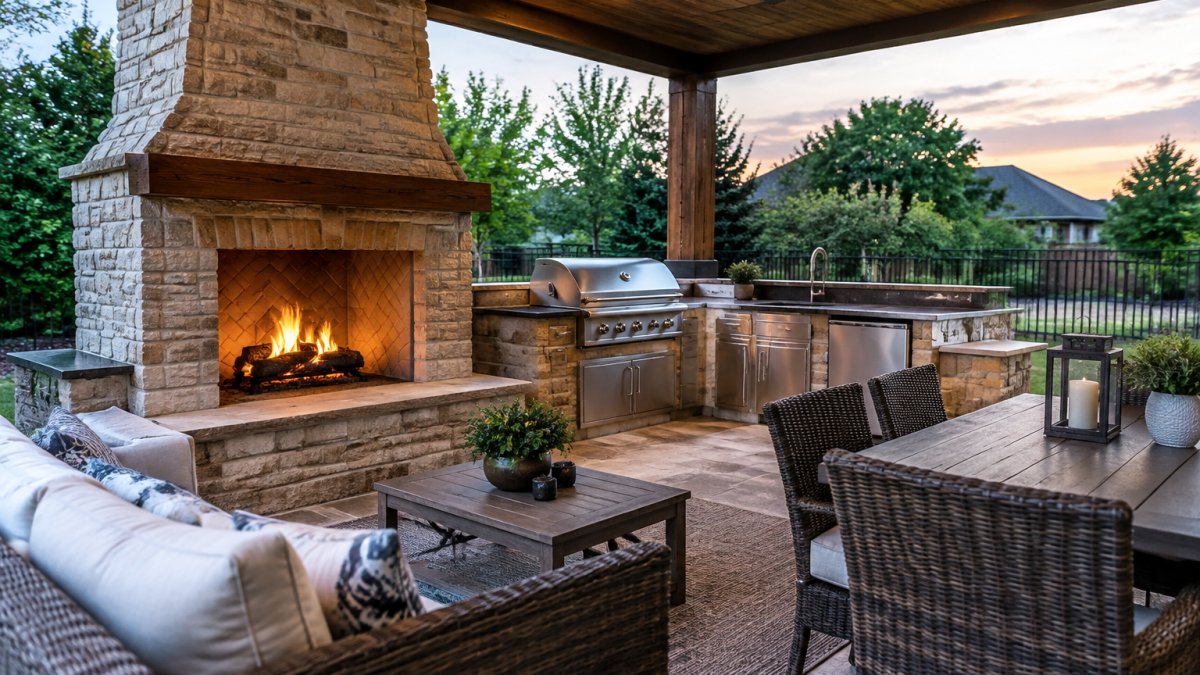
The fireplace should be the first thing guests see and the last thing they forget. Three layouts deliver that focal-point effect:
- L-shaped: fireplace on the long wall, grill station around the corner, bar seating facing the fire
- U-shaped: fireplace centered at the back, symmetrical counters framing it like a stage
- Linear: a long straight run with the fireplace at one end and the grill at the other
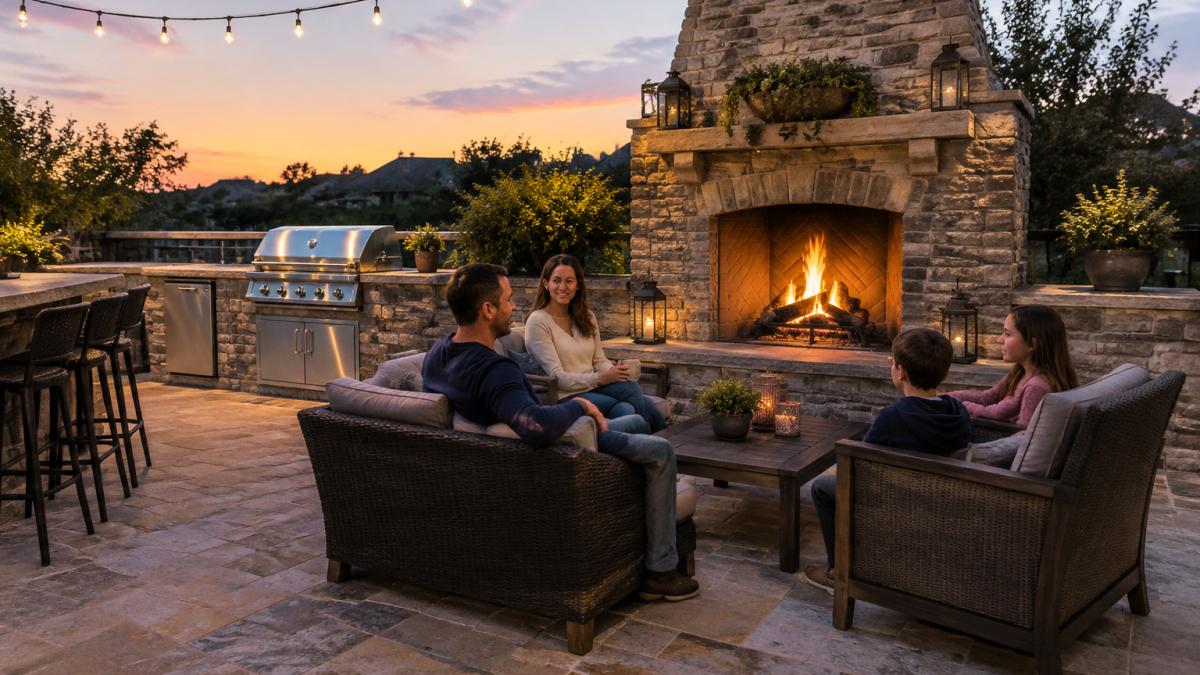
Multifunctional design matters here. The same wall that holds the fireplace can hide firewood storage or a wood-fired pizza oven. That's how you get more from less space.
Selecting a Fireplace Style: Rustic Stone, Modern, and Linear Designs
Style sets the mood, but durability sets the budget. Here's how the three main styles compare:
| Style | Look | Best For | Watch Out For |
|---|---|---|---|
| Rustic stone | Natural, textured, warm | Traditional homes, wooded lots | Mortar joints trap moisture |
| Modern stucco | Clean, smooth, minimal | Contemporary homes | Cracks if not sealed |
| Linear | Sleek, wide, gas-friendly | Small patios, city lots | Needs precise framing |
Rustic stone suits a relaxed, natural feel. Modern stucco reads clean and sharp. Linear fireplaces stretch wide and low, and they're the best pick for tight spaces.
Choosing Materials and Finishes That Hold Up Outdoors
Pick materials that shrug off sun, rain, and freeze-thaw cycles. Stone, concrete, and brick all hold up well. Flagstone makes a great hearth cap. Counter material should match the fireplace surround for a cohesive look. Seal porous stone every couple of years to keep moisture out.
Outdoor Kitchen Fireplace Cost: What Drives the Price
Outdoor kitchen fireplace cost depends on size, fuel type, materials, and site access, not on a single flat rate. We won't quote a number here, because honest pricing requires a site visit. What we can tell you is what moves the total up or down:
- Size and design: a wide linear unit costs more than a compact rustic one
- Fuel type: gas needs a plumber and gas line; wood needs a chimney
- Materials: natural stone costs more than stucco or manufactured block
- Site access: tight backyards slow crews and add labor
- Extras: lighting, seating walls, and storage add scope
Ask for an itemized quote so you can see each line. Any contractor who won't break it down is worth a second look.
Outdoor Kitchen Safety Codes, Clearances, and Ventilation
Safety is a design constraint, not a finishing touch. Clearances, ventilation, and permits should be settled before framing, because moving a firebox after the fact is expensive and sometimes impossible. Local building and fire departments enforce the rules, and most adopt national model codes such as the International Residential Code (IRC) and NFPA 1 and NFPA 211 for chimneys, fireplaces, and solid-fuel appliances.
Clearances to plan for:
- Maintain the manufacturer's listed clearance from the firebox opening to combustible walls, furniture, and overhead coverings. Listed gas and wood appliances specify these distances, and they are not negotiable.
- Use noncombustible materials for the surround, hearth, and any surface within the listed clearance zone. Stone, brick, concrete, and approved cement board are common choices; wood framing and composite decking are not.
- Keep the grill and fireplace on separate vent paths and respect the grill manufacturer's clearance to combustibles, which often differs from the fireplace's.
- Leave airflow space behind and around the unit as the listing requires; do not pack insulation or storage against the firebox.
- Screen or cap the flue to control embers and keep out animals and rain.
Permits and inspection sequence. A jurisdiction-aware checklist keeps the project moving:
- Confirm with the local building department whether the fireplace, gas line, and any covered structure require permits.
- Submit plans showing the appliance listing, clearances, flue termination, and gas line routing.
- Have licensed trades run gas and electrical lines and schedule rough-in inspections before closing walls.
- Schedule the final inspection after the appliance is set and the flue is terminated.
- Keep the manufacturer's installation manual on site; inspectors commonly ask for it.
Venting a fireplace in a covered kitchen area. A covered patio changes the venting math. Wood smoke needs a chimney that terminates above the roofline or per the listing, and the termination must clear nearby windows, doors, and combustible roof surfaces. Gas units still need clearance and airflow, and some listings restrict installation under certain overhead structures. Never enclose a firebox in a sealed structure. If your patio has a pergola or roof, plan the vent and its termination before framing starts.
For fire-safety guidance tuned to a dry climate, read our fire pit safety tips for dry Texas summers.
Fuel and Appliance Choice: Wood-Burning or Gas
Fuel choice is the decision that locks in your utility rough-ins, clearance requirements, and long-term maintenance, so make it before you finalize the layout. Selecting between these fuel sources often hinges on the specific infrastructure available at your site, which makes understanding the nuances of propane vs natural gas essential for balancing convenience with installation costs.
Wood-burning fireplaces deliver the crackle, scent, and radiant heat that many homeowners picture when they imagine an outdoor fireplace. They also demand the most infrastructure.
Gas fireplaces run on natural gas or propane and offer push-button start, steady heat, and no ash cleanup. Natural gas requires a buried gas line run by a licensed plumber or gas fitter, with a shutoff valve accessible outside. Propane requires tanks and a regulator, and tank placement affects both refill logistics and clearances.
Bioethanol fireplaces burn liquid fuel and produce a real flame without a chimney or gas line, which makes them attractive where running utilities is impractical. They produce less heat than wood or gas, require fuel storage and refilling, and are best treated as ambiance features rather than primary heat sources.
A few practical rules of thumb help narrow the choice:
- Choose gas when convenience, tighter lots, or covered structures matter most.
- Choose wood when atmosphere, radiant heat, and an open yard are priorities and you will maintain a chimney.
- Choose bioethanol only when utility runs are impossible and you accept lower heat output.
- Match the appliance to the cooking zone: keep the grill on its own fuel and vent path, and do not share a gas line sizing calculation between grill and fireplace without confirming capacity.
If you are still weighing fire pit versus fireplace, our fire pit vs fireplace comparison walks through the trade-offs.
Building the Cozy Atmosphere: Lighting, Seating, and Weatherproofing
Ambiance is engineered, not accidental. Layer three light sources: warm string lights overhead, low path lights, and the fire itself. Arrange seating in a curve facing the flames. Add a weatherproof cover for the firebox and seal stone annually. A cozy space invites people to stay, and staying is the whole point of entertaining outdoors.
Planning Your Outdoor Kitchen Fireplace With Moises Pizana Hardscapes
A fireplace transforms an outdoor kitchen from a cooking spot into a gathering place. The planning steps above give you a solid start, but the build is where details matter most. Our team handles design and installation in-house, with no subcontractors and more than 15 years of crew experience. We build custom patios, outdoor kitchens, and fire features tailored to your yard and your vision.
Ready to move from sketch to stone? Explore our fire pit and outdoor fireplace installation service and request a quote. For layout help, see our guide on planning an outdoor kitchen layout, and for cooking-zone design, read how to design a functional outdoor cooking area.
Frequently Asked Questions
Can you put a fireplace on a patio?
Yes. A patio fireplace is one of the most common additions to an outdoor living space, and it can be built as a standalone feature or integrated into an outdoor kitchen. The key is planning the location before the patio is poured or the hardscape is laid, so the footing, gas line, and clearances are handled correctly. A built-in fireplace needs a proper base and a noncombustible surround, while a freestanding unit gives you more flexibility if the patio already exists.
How much does it cost to add an outdoor fireplace to a kitchen?
There is no single number, because outdoor kitchen fireplace cost depends on the fuel type, the size of the unit, the stone or stucco finish, whether a gas line has to be run, and whether the fireplace is part of a larger build. Ask your contractor for a written scope that separates the fireplace from the rest of the kitchen so you can see exactly what each piece adds.
What are the safety requirements for outdoor kitchen fireplaces?
Outdoor kitchen safety codes center on clearances, ventilation, and materials. Combustible surfaces like wood framing, pergola beams, and siding need to stay a set distance from the firebox and flue, and that distance varies by appliance, so always follow the manufacturer's listed clearances. Covered areas need proper venting so smoke and carbon monoxide do not collect under a roof. Local permitting rules also apply, and your contractor should confirm what your municipality requires before work starts.
Should the fireplace be wood-burning or gas for an outdoor kitchen?
Wood-burning gives you real crackle and smell but needs a chimney, a steady wood supply, and more cleanup. Gas lights instantly, produces no ash, and is easier to place under a covered structure with the right venting, which is why it is often the practical pick for an outdoor kitchen. If you want the look of a wood fire without the chimney, a bioethanol or gas insert can work well. Match the fuel to how often you will actually use the space.
Your backyard deserves more than a grill against a fence. Get started with Moises Pizana Hardscapes and turn your outdoor kitchen into the warm, functional centerpiece your family will use all year.