 blog
Are Durable Outdoor Kitchen Designs Worth It for Small Backyards?
Last Updated: October 28, 2026
Quick Summary
Durable outdoor kitchen designs for small backyards are worth it because a compact kitchen concentrates heat, moisture, and traffic into a tight footprint, so cheap countertops and untreated cabinet frames break down faster. Choose compact appliances, vertical storage, and climate-matched countertop materials, then reseal stone and concrete annually to protect your patio and resale value.
- Keep the cook's path short with an L-shaped or galley layout that fits tight patios.
- Vertical storage is the biggest space saver in a small-footprint design.
- Measure the footprint first, then choose compact appliances that leave room for prep.
- Skipping the annual seal on stone and concrete is the most common way a small kitchen ages fast.
- Permanent gas lines and hardwired electrical circuits typically require a permit and inspection.
Table of Contents
- Why Durable Outdoor Kitchen Designs Matter in a Small Backyard
- Space-Saving Small Backyard Outdoor Kitchen Layout Ideas
- Small Outdoor Kitchen Ideas That Maximize Every Square Foot
- Outdoor Kitchen Countertop Materials Built for Texas Weather
- Is a Modular Outdoor Kitchen Right for Your Backyard Footprint?
- Permits, Codes, and Maintenance for Small Backyard Kitchens
- Planning Your Outdoor Kitchen Build With Moises Pizana Hardscapes
- Frequently Asked Questions
Why Durable Outdoor Kitchen Designs Matter in a Small Backyard
A small backyard has no room for a kitchen that fails.
Small yards make durability more important, not less.
Most guides treat small outdoor kitchen ideas as a style question. The real question is whether the build survives ten summers of Texas sun, sudden downpours, and heavy grill use.
Below, we cover layouts, countertop materials, and modular options for compact kitchens.
Space-Saving Small Backyard Outdoor Kitchen Layout Ideas
The best small backyard outdoor kitchen layout starts with one rule: keep the cook's path short. A tight triangle between grill, prep area, and storage beats a long counter every time.
L-Shaped and Galley Layouts for Tight Patios
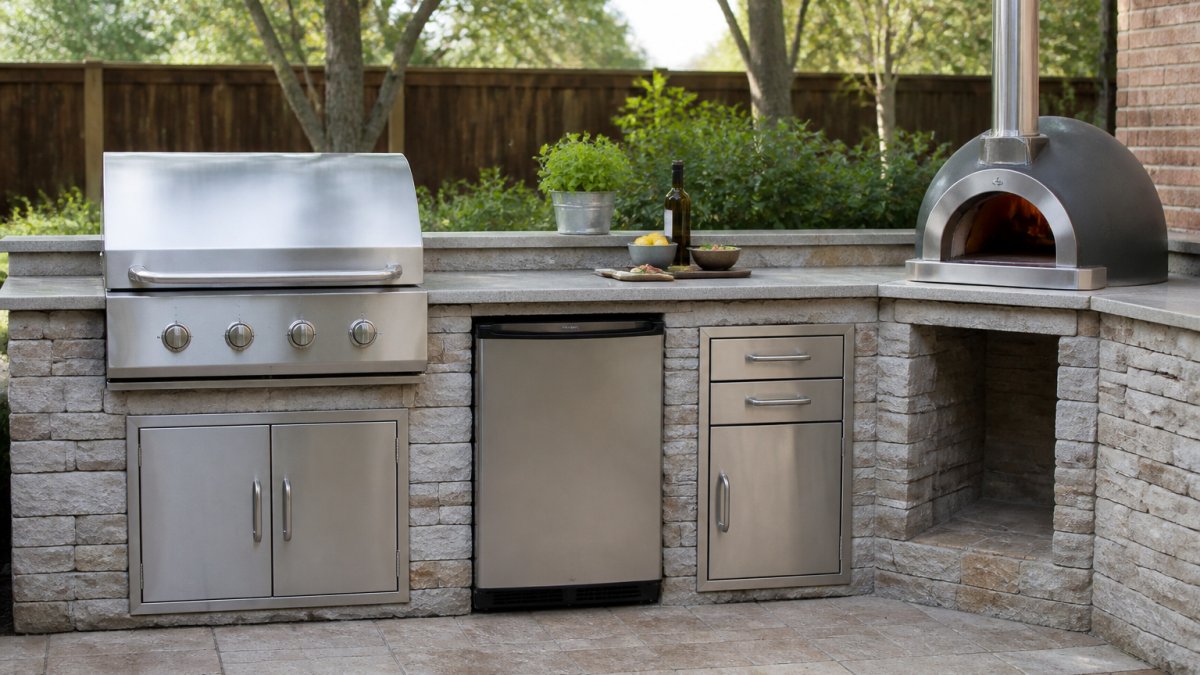
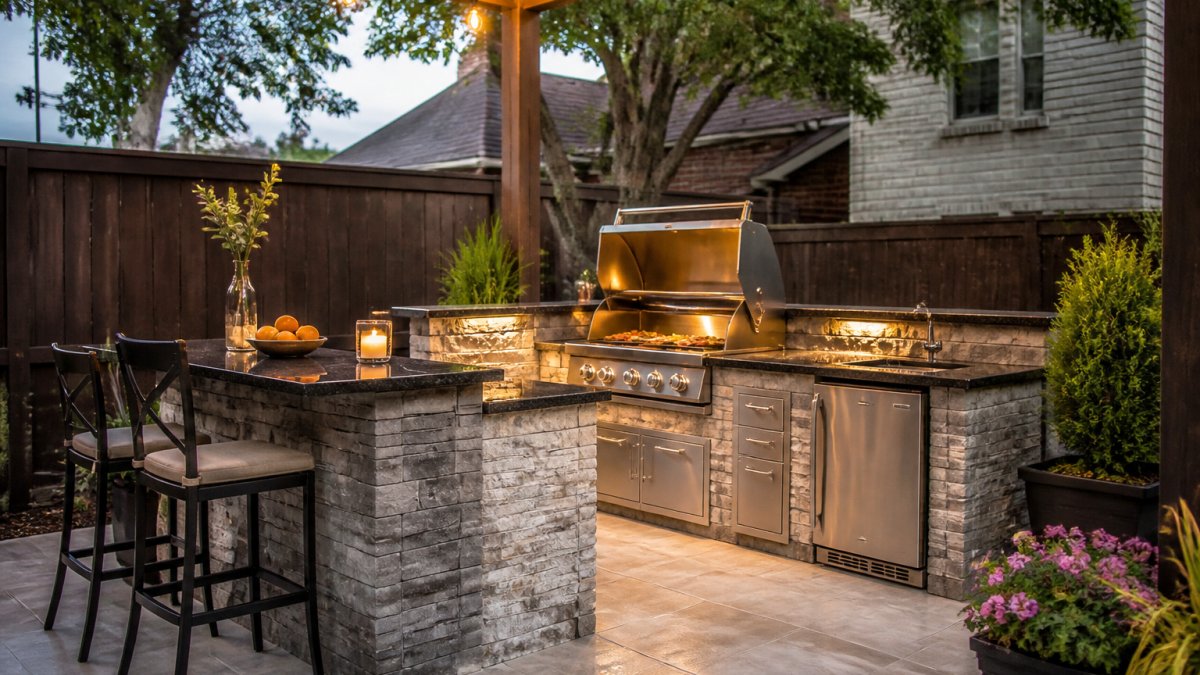
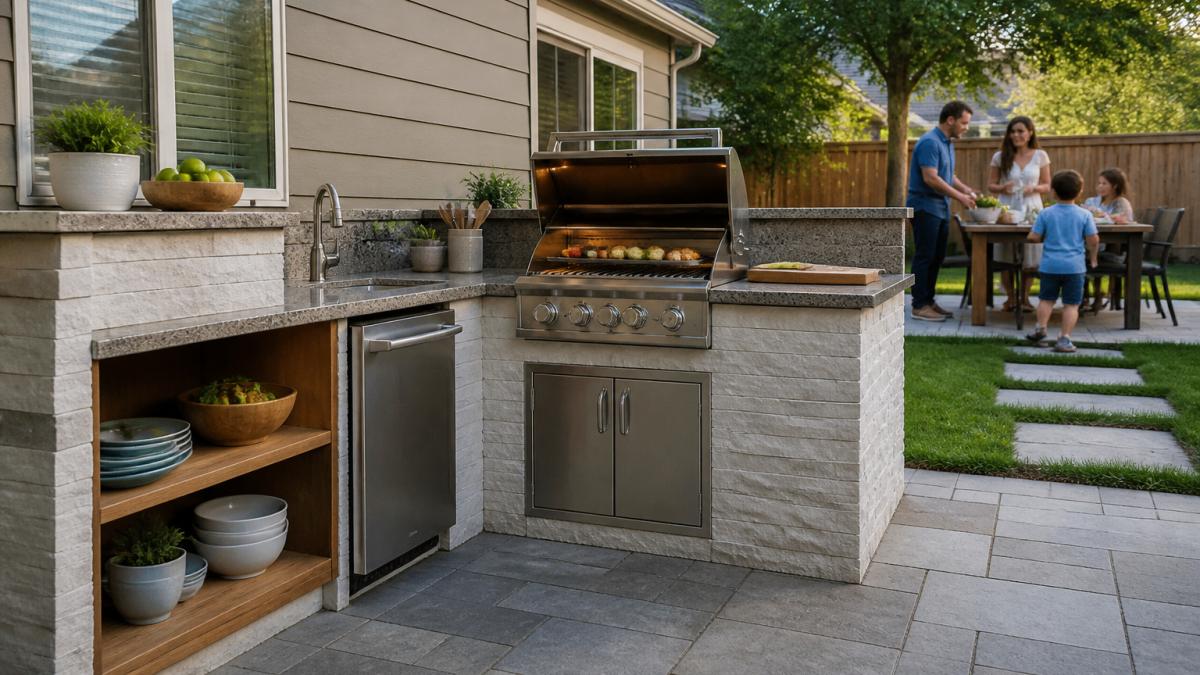
L-shaped layouts fit into a corner and leave the rest of the patio open: the short leg holds the grill, the long leg gives you prep space and an outdoor sink. For narrow patios, a galley layout runs everything along one wall. Maximizing these compact footprints requires careful selection of outdoor grill accessories that integrate seamlessly into your chosen configuration without cluttering the limited workspace.
Built-In Grill Islands and Vertical Storage
A built-in grill island anchors the kitchen and frees up floor space. Pair it with vertical storage, wall-mounted shelves, tall cabinets, or a slatted tool rack. Vertical storage is the biggest space saver in a small-footprint design, moving clutter off the counter and into the air.
Small Outdoor Kitchen Ideas That Maximize Every Square Foot
Compact does not mean cramped. The strongest small outdoor kitchen ideas use multi-functional furniture and smart storage to make a tiny footprint feel generous.
Try these moves:
- A bar-height counter that doubles as a dining table and a prep surface
- A fold-down or pull-out shelf beside the grill for plating
- Under-counter drawers instead of open shelving to hide clutter
- A compact outdoor sink set into the same run as the grill
For more information, see our guide to 5 affordable outdoor kitchen appliances for small backyards.
A common mistake is buying full-size appliances for a small island. Measure the footprint first, then choose compact appliances that leave room for a real prep area, that is where the cooking actually happens.
Outdoor Kitchen Countertop Materials Built for Texas Weather
Outdoor kitchen countertop materials decide how well the whole build ages. In this climate, the surface must handle intense sun, heat, sudden storms, and, depending on where you sit, salt air, sustained humidity, or freeze-thaw cycles. The durability question is which surface survives your backyard's specific weather, and what it takes to keep it that way.
Here is how the main options compare on the factors that actually drive long-term performance:
| Material | Heat tolerance | Moisture & stain behavior | Freeze-thaw risk | Maintenance cadence | Best use in a small kitchen |
|---|---|---|---|---|---|
| Granite | High; handles hot pans and grill-side heat | Low porosity when sealed; can stain if sealer wears | Low when sealed; water intrusion at seams is the weak point | Reseal annually; wipe spills promptly | Primary prep and grill surround |
| Natural stone (marble, limestone, travertine) | Moderate to high; marble can etch | Porous types absorb water and stain without sealing | Moderate to high on porous types; sealing is non-negotiable | Reseal every 6-12 months depending on porosity | Covered patios and low-splash zones |
| Concrete | High; no melting or scorching | Good when sealed; unsealed concrete wicks water | High if unsealed; hairline cracks widen with freeze-thaw | Reseal every 2-3 years; patch cracks early | Custom shapes and tight footprints |
| Stainless steel | Excellent; no heat damage | Non-porous; corrosion-resistant | None | Wipe down; check for scratches and chloride pitting | Built-in grill surrounds and wet zones |
| Teak wood | Moderate; use trivets near the grill | Good when oiled; raw teak grays and raises grain | Low when oiled and drained | Oil twice a year; sand lightly as needed | Warm accents and bar tops |
| Porcelain tile | High | Low porosity; grout lines are the weak point | Low on the tile; grout can crack | Reseal grout annually; clean with pH-neutral cleaner | Budget-friendly full-surface tops |
Match the material to your climate, not just your style
Most countertop advice is climate-blind. A surface that performs in a dry, mild yard can fail in a coastal or freeze-thaw yard. Use this as a starting filter:
- Coastal and salt-air yards: prioritize stainless steel for the grill surround and sealed granite or porcelain for the top. Salt accelerates corrosion, so specify marine-grade or 304 stainless hardware and rinse surfaces periodically. Teak holds up better than most woods in salt air but still needs oiling.
- High-humidity yards: porosity is the enemy. Sealed granite, porcelain tile, and stainless steel outperform porous stone and unsealed concrete. Ventilate the underside of the counter so moisture does not trap against the cabinet frame.
- Freeze-thaw yards: water intrusion cracks surfaces. Sealed concrete and sealed granite are workable, but seams and edges are where failures start; porous stone and unsealed concrete are highest-risk. Slope the top slightly away from the house and seal annually.
- Intense-sun, hot-summer yards: heat tolerance matters most next to the grill. Granite, concrete, stainless steel, and porcelain handle hot pans; wood and some composites need trivets. Dark surfaces get uncomfortably hot at the bar, so consider a lighter tone for seating areas.
The trade-offs most tables skip
- Granite vs. natural stone: granite is denser and more stain-resistant than marble or limestone, making it the safer default for a working counter. Natural stone wins on look but demands more sealing discipline.
- Concrete vs. granite: concrete gives custom shapes and a seamless look in a tight footprint, but it is the most crack-prone option if sealing lapses. Granite is more forgiving.
- Stainless vs. everything else: stainless is the most corrosion-resistant surface for the grill surround, but it scratches and shows fingerprints. Use it as an accent around the grill rather than the whole top.
- Teak vs. composite: teak is real wood that can be refinished; composites are lower-maintenance but fade and are harder to repair. In a small kitchen, teak is usually an accent, not the primary work surface.
For more information, see our outdoor kitchen planning guide for homeowners.
Is a Modular Outdoor Kitchen Right for Your Backyard Footprint?
A modular outdoor kitchen is a set of customizable modules that you arrange to fit your space.
Best for: renters, homeowners who want to phase a build, and yards with odd shapes. Skip if: you want a seamless custom island with a continuous stone top.
For more information, see our outdoor kitchen vs a built-in grill for small backyards.
Permits, Codes, and Maintenance for Small Backyard Kitchens
Two things sink small outdoor kitchen projects: skipped permits and skipped maintenance. Both are avoidable. This section covers the permitting triggers for compact builds and a material-specific maintenance schedule you can follow.
Permitting and code triggers in a small backyard
A small footprint does not mean a small regulatory footprint. These triggers most often apply to compact outdoor kitchens. Rules are set locally, so confirm with your city or county building department before you build, knowing what to ask about saves weeks.
- Gas lines: A permanent natural-gas or propane line to a grill almost always requires a permit and inspection. This includes extending an existing line, adding a quick-disconnect, and installing a regulator. Portable propane tanks generally do not trigger a gas permit, but the appliance clearances still apply.
- Electrical: Any hardwired circuit, outlets, lighting, a refrigerator, a rotisserie motor, typically needs a permit. Outdoor receptacles require GFCI protection and weather-rated covers under the National Electrical Code (NEC), which most jurisdictions adopt. If you are running a new circuit from the panel, expect an inspection.
- Structures and footings: A built-in island, a pergola, or a roof over the kitchen can trigger structural permits and setback requirements. In tight urban lots, setbacks are often the binding constraint, a kitchen that fits the patio may still violate a side-yard or rear-yard setback.
- Zoning and impervious cover: Some jurisdictions limit the percentage of a lot that can be covered by impervious surfaces. A concrete or paver patio plus an island counts toward that limit. Check before you pour.
The International Code Council publishes the model codes, the International Residential Code (IRC) and International Building Code (IBC), that many jurisdictions adopt, and your local office confirms which edition and amendments apply to your address.
A material-specific maintenance schedule
Durability is not a purchase decision, it is an upkeep decision. This schedule is the minimum most practitioners recommend for a small kitchen in regular use. Coastal and freeze-thaw yards need the shorter end of every interval.
| Material or component | Task | Interval |
|---|---|---|
| Granite and sealed natural stone | Reseal; wipe spills promptly | Annually (every 6 months in coastal or freeze-thaw climates) |
| Concrete countertop | Reseal; patch hairline cracks | Every 2-3 years; inspect cracks each season |
| Teak wood | Oil; sand lightly as grain raises | Twice a year |
| Stainless steel | Wipe down; inspect for scratches and chloride pitting | Monthly; rinse more often in salt air |
| Outdoor cabinetry | Tighten hinges; check door and drawer seals | Each season |
| Grill | Clean burners and drip tray; check gas connections for leaks | After heavy use; deep clean seasonally |
| Drainage and slope | Clear debris; confirm water drains away from the house | Each season, especially before winter |
| Fasteners and hardware | Check for corrosion or loosening | Annually |
What actually fails first in a small kitchen
In a compact footprint, failures concentrate. The three most common are water intrusion at seams and edges, corrosion on fasteners and lower-grade hardware, and skipped sealing on stone or concrete. Each is cheap to prevent and expensive to fix once the surface cracks or the frame softens, and with no second prep zone, a failed counter or cabinet takes the whole workspace out of service.
Planning Your Outdoor Kitchen Build With Moises Pizana Hardscapes
We build outdoor living spaces.
At Moises Pizana Hardscapes, we build functional outdoor living spaces, including custom patios and outdoor kitchens. We do not subcontract the work, and our crew has more than 15 years of experience.
Before you commit to a build, it helps to know what to expect. See the average outdoor kitchen cost in Dallas to plan your budget. For a quote, contact Moises Pizana Hardscapes.
Frequently Asked Questions
What is the best layout for a small outdoor kitchen?
A small-backyard layout can be planned around the available space and the homeowner's needs.
How do you make a small outdoor kitchen durable?
Discuss material and construction choices with your contractor.
Can you fit an outdoor kitchen in a small backyard?
A small backyard may accommodate an outdoor kitchen, depending on the available space and the homeowner's plans.
Is a modular outdoor kitchen a good choice for a small space?
Whether a modular outdoor kitchen suits a small space depends on the project and the homeowner's preferences.
A small backyard still deserves a kitchen that lasts. If you are tired of patching a failing patio or want a compact cooking space built to handle the weather, we can help. Moises Pizana Hardscapes brings expert hardscape design, fast building with precision, and a full range of services that includes patios, retaining walls, and outdoor kitchens. Get started with Moises Pizana Hardscapes and build an outdoor kitchen that holds up season after season.