 blog
Modern Covered Patio Ideas With Lighting
Table of Contents
- Modern Covered Patio Lighting: Creating Functional Outdoor Living Spaces
- Covered Patio Lighting Ideas for Every Design Style
- Patio Ceiling Lights: Overhead Illumination for Your Space
- Outdoor Pendant Lights for Patio: Layering Ambient and Task Lighting
- Wall Sconces, String Lights, and Accent Lighting
- Brightness, Color Temperature, and Weather Ratings
- Energy Efficiency, Durability, and Installation Considerations
- Frequently Asked Questions
Last Updated: October 18, 2026
Modern Covered Patio Lighting: Creating Functional Outdoor Living Spaces
A well-lit covered patio transforms your backyard into a functional outdoor living space that works day and night. The right lighting design combines aesthetics with practicality, creating an inviting atmosphere while ensuring safety and usability.
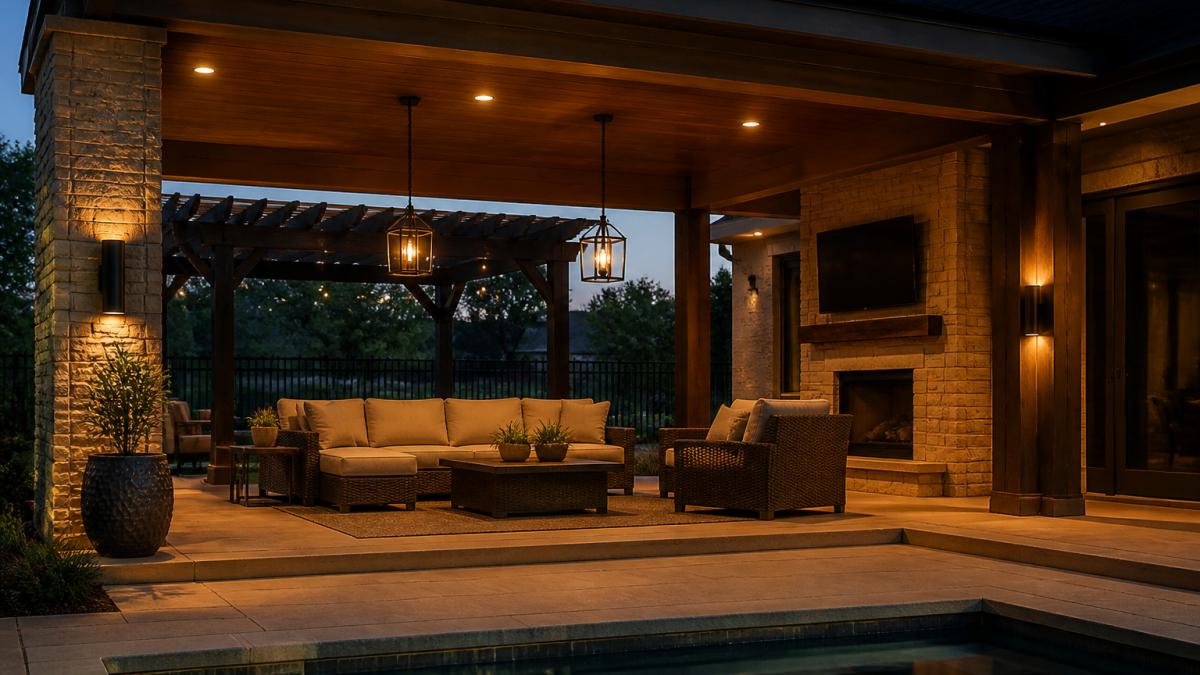
The challenge most homeowners face is choosing the right fixtures and placement without overwhelming their design. Too many lights create glare and visual clutter. Too few leave dark corners and unsafe walkways.
Covered Patio Lighting Ideas for Every Design Style
Modern covered patio ideas with lighting work best when they match your home's overall aesthetic. Contemporary designs favor clean lines and minimalist fixtures.
Your fixture choices communicate style before they illuminate. A sleek flush-mount ceiling light signals modern design.
Consider your patio's material and finish when selecting fixtures. Concrete patios pair well with industrial-style lighting.
The key is consistency. Choose 2-3 fixture styles and repeat them throughout your space rather than mixing too many different designs.
Patio Ceiling Lights: Overhead Illumination for Your Space
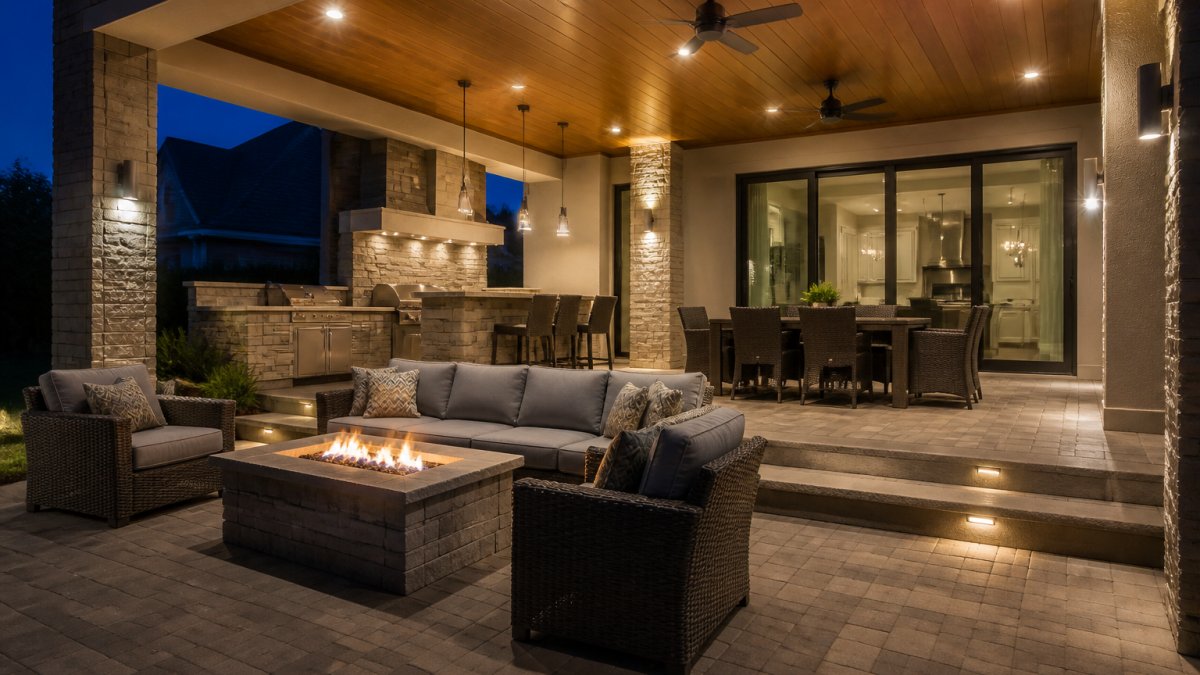
Overhead ceiling lights form the backbone of covered patio lighting. They provide the primary illumination and set the tone for the entire space. Two main options dominate modern covered patio ideas with lighting: flush-mount fixtures and recessed lighting.
Flush-Mount and Semi-Flush Fixtures
Flush-mount fixtures attach directly to your ceiling and work well in patios with standard 8-foot heights.
These fixtures are ideal for:
- Patios with limited vertical clearance
- Spaces where you want a clean, uncluttered look
- Areas requiring even, diffused light coverage
Flush-mount fixtures come in countless styles. Glass domes provide clean, modern lines. Fabric shades add softness. Metal cages offer industrial appeal.
Installation is straightforward, making flush-mount fixtures a popular choice for DIY upgrades. Most connect to existing ceiling wiring without major modifications. Professional installation ensures proper electrical connections and safety compliance.
Recessed Lighting for Covered Patios
Recessed lights sit flush within your ceiling, creating a seamless appearance.
Recessed lighting advantages:
- Clean, minimalist aesthetic
- Adjustable beam angles for targeted illumination
- Can be dimmed for mood adjustment
- Works well with low ceilings
Installation requires cutting holes in your ceiling and running electrical wiring. This is typically a job for licensed electricians. The investment pays off through years of reliable, maintenance-free operation.
Space recessed lights 4-6 feet apart for even coverage across your patio. Closer spacing creates brighter, more uniform light. Wider spacing saves on fixtures but may leave darker areas.
Outdoor Pendant Lights for Patio: Layering Ambient and Task Lighting
Pendant lights hang from your ceiling on chains or rods, creating focal points while providing functional illumination.
Pendants work best in clusters of 2-4 fixtures, spaced evenly across your patio.
Height matters significantly. Hang pendants 12-18 inches below your ceiling for adequate clearance.
Material choices affect both style and durability. Metal pendants withstand weather well and suit modern designs. Glass shades provide clear light distribution.
Consider integrated LED pendants for energy efficiency.
Wall Sconces, String Lights, and Accent Lighting
Wall sconces mounted on patio columns or exterior walls add warmth and create visual layers.
Place wall sconces 5-6 feet high on vertical surfaces. This height provides comfortable ambient light without creating glare.
String lights add festive ambiance and work well for entertaining. Cafe-style strings create a relaxed, inviting atmosphere. Edison bulbs offer vintage warmth.
Accent lighting highlights architectural features or landscaping. Uplighting on columns creates drama. Downlighting through pergolas casts interesting shadows.
Layer these elements strategically:
- Overhead fixtures for primary illumination
- Wall sconces for ambient warmth
- String lights for festive occasions
- Accent lighting for visual interest
Brightness, Color Temperature, and Weather Ratings
Brightness, color temperature, and weather protection are the three specs that decide whether a covered patio feels inviting or uncomfortable. Get them right and the space works for dinner, conversation, and late-night reading. Get them wrong and you get glare, dark corners, or fixtures that fail after one storm season.
Brightness: lumens per square foot
Brightness is measured in lumens, not watts. For a covered patio, a common planning range is 10-20 lumens per square foot for ambient light, with task zones (dining tables, grills, prep counters) pushed toward the higher end. A 200-square-foot patio therefore needs roughly 2,000-4,000 lumens of ambient light, distributed across several fixtures rather than concentrated in one bright source. Spreading lumens across fixtures reduces harsh shadows and glare.
A simple planning method:
- Measure the patio's square footage.
- Multiply by 10 for relaxed ambient light, or 20 for entertaining and dining.
- Divide by the lumen output of your chosen fixtures to estimate fixture count.
- Add dedicated task fixtures over dining and cooking zones.
Color temperature: Kelvin ranges by activity
Color temperature (Kelvin) changes mood more than brightness does. Most residential lighting practitioners use these ranges:
- 2700K (warm white): cozy, intimate, best for lounging and dining.
- 3000K (soft white): slightly crisper, still warm, a good all-purpose choice.
- 3500-4000K (neutral white): cleaner and more modern, suited to task areas and contemporary designs.
- 5000K and above (cool white): clinical in social spaces; usually reserved for utility areas.
A practical approach is to keep ambient and accent lighting at 2700-3000K and reserve 3500-4000K for task fixtures over grills or prep surfaces. Mixing temperatures on the same circuit can look disjointed, so specify one temperature per zone.
Glare and light spill
Glare comes from seeing the light source directly or from too much contrast between fixture and background. Reduce it by:
- Choosing fixtures with diffusers, lenses, or shielded bulbs.
- Aiming adjustable recessed lights away from seating eye level.
- Keeping pendant bottoms above seated eye height (typically 12-18 inches below the ceiling works for 8-9 foot ceilings).
- Adding dimmers so brightness can drop as the evening progresses.
Light spill matters at property lines. Shielded fixtures and downward-aimed optics keep light on your patio instead of your neighbor's windows.
Weather ratings: damp vs. wet locations
Outdoor fixtures carry a location rating under the National Electrical Code (NEC):
- Damp location: protected from direct rain but exposed to moisture. Suitable under a solid roof or soffit.
- Wet location: exposed to direct rain, snow, or irrigation. Required where the fixture can get wet.
A covered patio with a solid roof usually allows damp-rated fixtures, but open sides, pergolas, and areas reached by sprinklers or wind-driven rain call for wet-rated fixtures. Check the label on the fixture, not the marketing description.
Ingress protection (IP) ratings add another layer. IP65 handles dust and water jets; IP44 resists splashing and dust. Match the IP rating to exposure, and remember that a higher IP rating does not replace the NEC location rating.
Electrical safety: GFCI and when to hire an electrician
Outdoor receptacles and lighting circuits are required to have ground-fault circuit interrupter (GFCI) protection under the NEC. GFCI protection shuts off power when current leaks to ground, reducing shock risk in damp conditions.
Hire a licensed electrician when:
- You need new circuits, receptacles, or a subpanel.
- You are installing recessed lights that require cutting into the ceiling and running new cable.
- The existing wiring is old, undersized, or ungrounded.
- You are unsure whether the circuit is GFCI-protected.
Simple fixture swaps on an existing, properly rated circuit are often DIY-friendly, but anything involving new wiring, ceiling penetrations, or panel work belongs with a licensed electrician and a permit where local rules require one.
Energy Efficiency, Durability, and Installation Considerations
Energy use, fixture lifespan, and installation method determine the real cost of a covered patio lighting plan. The upfront price is only part of the story; operating cost, replacement frequency, and whether the work needs a licensed electrician all shape the total.
LED vs. incandescent vs. solar: realistic trade-offs
LED fixtures are the default for modern covered patios because they use a fraction of the energy of incandescent bulbs and last far longer.
Solar fixtures avoid wiring entirely, which makes them attractive for pergolas and open covers.
Incandescent and halogen fixtures remain available but run hotter, use more energy, and need more frequent bulb changes. For a patio used nightly, the operating cost difference adds up.
Estimating operating cost
Operating cost is watts × hours × rate. A simple method:
- Add up the wattage of all fixtures on the patio.
- Multiply by nightly hours of use.
- Multiply by your electricity rate per kilowatt-hour (kWh).
- Multiply by 365 for an annual estimate.
Because electricity rates vary by utility and region, use your own bill's rate rather than a national average. The point is comparison: a lower-wattage LED plan will consistently cost less to run than an equivalent incandescent plan.
Lifespan and maintenance
LED fixtures often carry rated lifespans in the 25,000-50,000 hour range, though heat, moisture, and poor installation shorten real-world life. Maintenance considerations:
- Choose fixtures with replaceable components where possible.
- Keep drains and weep holes clear on fixtures rated for wet locations.
- Expect fabric shades and open cages to collect debris and require cleaning.
- Smart bulbs and integrated LEDs may become obsolete; check whether the fixture allows replacement.
Smart controls and dimming
Dimmers, timers, motion sensors, and app-controlled smart switches reduce waste by matching light output to actual use. Practical notes:
- Confirm the dimmer is compatible with the fixture's driver or bulb; mismatches cause flicker or failure.
- Smart switches require a neutral wire in the switch box, which older homes may lack.
- Motion sensors work well for path and security lighting but can be annoying in seating areas.
DIY vs. professional installation
A useful split:
- DIY-friendly: swapping a flush-mount or pendant on an existing, properly rated and GFCI-protected circuit; plug-in string lights; solar accents.
- Professional: new circuits, recessed lighting, ceiling penetrations, panel work, and any installation where the circuit's GFCI status or wiring condition is unknown.
Permits may be required for new electrical work depending on local rules; a licensed electrician can confirm. Retrofitting an older patio usually costs more than building lighting into new construction because wiring, boxes, and circuits may need to be added.
Budget tiers
Because fixture and labor prices vary widely by market and product, treat these as planning tiers rather than quotes:
- Low: plug-in string lights, solar accents, and battery fixtures; no wiring changes.
- Mid: fixture swaps on existing circuits, dimmers, and smart switches.
- High: new recessed lighting, added circuits, and integrated smart systems requiring an electrician and possibly a permit.
Get itemized quotes that separate fixtures, labor, and any permit fees so you can compare accurately.
Frequently Asked Questions
What's the best type of lighting for a covered patio?
A layered approach works best: combine ambient overhead lighting (recessed or flush-mount fixtures) for overall illumination, task lighting (pendant lights or directional fixtures) over seating or dining areas, and accent lighting (wall sconces or string lights) to create mood. This combination ensures your covered patio is both functional and visually appealing while accommodating different activities and times of day.
How many lumens do I need for covered patio lighting?
The appropriate lumen output for covered patio lighting depends on the size of the space and its intended use. Task areas like dining tables may require brighter light, while accent lighting can use lower levels. Consider dimmable options to adjust brightness based on the time of day and activity.
Can you use pendant lights outdoors under a patio cover?
Yes, outdoor pendant lights work well under covered patios, especially when the cover protects them from direct rain. Choose fixtures rated for damp or wet locations (look for IP ratings of IP54 or higher). Pendant lights are ideal for creating focal points above dining tables or seating areas and help define zones within your outdoor space while adding modern style and warmth.
What's the difference between recessed lighting and other ceiling fixtures for covered patios?
Recessed lighting sits flush with the ceiling, creating a clean, modern look and providing even overhead illumination without visual obstruction. Unlike flush-mount or pendant fixtures, recessed lights don't hang down and work well in tight spaces. However, they require more installation work and ceiling access. Recessed lighting for covered patios is excellent for contemporary designs and works well when combined with pendant or wall-mounted accent lights.