 listicle
Professional Outdoor Kitchen Installation DFW: 2026 Guide
Table of Contents
- How to Evaluate Professional Outdoor Kitchen Installation DFW Contractors
- What Custom Outdoor Kitchen Design Cost Really Includes
- Outdoor Kitchen Installation Timeline: From Site Assessment to Backyard Cooking
- Best Materials for Outdoor Kitchens in North Texas Heat and Clay Soil
- Utility Planning: Gas Lines, Electrical, and Drainage Solutions
- The ROI of a Built-In Grill Island and Outdoor Dining Area
- Why Moises Pizana Hardscapes Is a Top Choice for Turnkey Installation
- Conclusion
- Frequently Asked Questions
Last Updated: September 4, 2026
Professional outdoor kitchen installation DFW projects require more planning than most homeowners expect, from utility routing to material selection that survives Texas summers. This guide from Moises Pizana Hardscapes breaks down the process, what drives cost, and how to choose a contractor.
How to Evaluate Professional Outdoor Kitchen Installation DFW Contractors
Ask every candidate how they handle the three things that most often go wrong: drainage, structural support, and utility connections. A professional contractor should answer with specific solutions, not vague assurances.
Verify that the crew you meet is the crew that builds. Many companies subcontract construction, creating accountability gaps. Ask whether work is in-house and request examples of recent local projects.
Check for structural integrity knowledge. Your contractor should explain how they account for expansive clay soil, which shifts with moisture changes. Ask about rebar spacing, footing depth, and how the grill island ties into existing hardscape.
What Custom Outdoor Kitchen Design Cost Really Includes
In the DFW market, professional outdoor kitchen installation costs cluster into three practical tiers based on what you build and the materials you choose. These are planning ranges, not quotes.
Entry-Level Outdoor Kitchen: $12,000 - $18,000
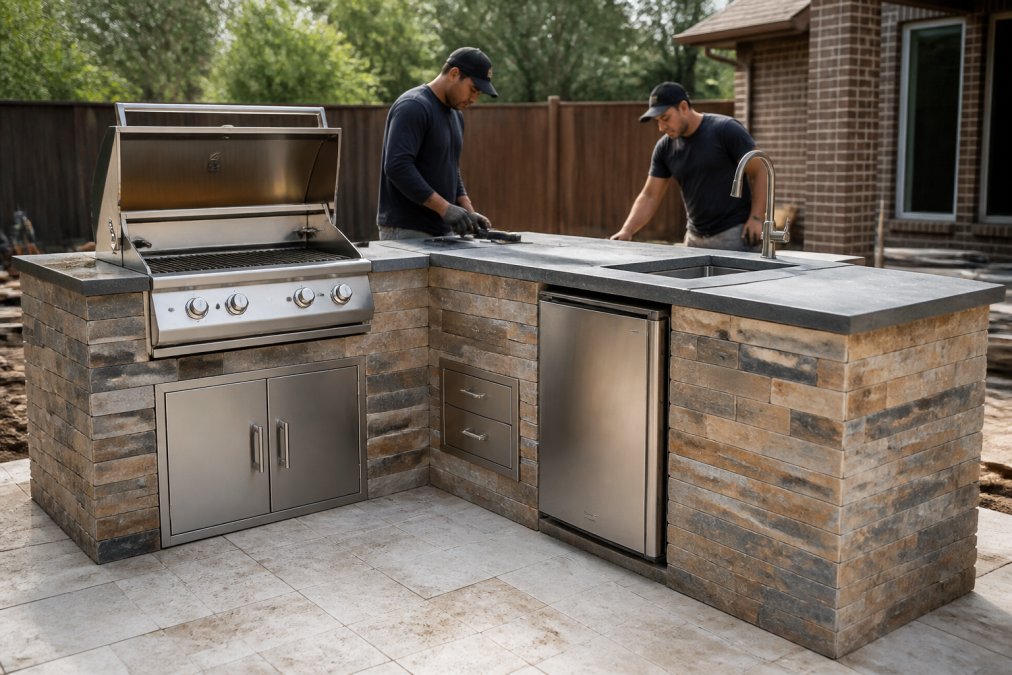
This tier covers a functional cooking station: a concrete block and stucco or thin stone veneer base, a standard 36-inch built-in gas grill, a single access door, and a basic granite or concrete countertop. The footprint is typically 8 to 10 linear feet, with no sink, refrigerator, or custom storage. Utility work is minimal: one gas line stub and one electrical outlet.
Mid-Range Outdoor Kitchen: $25,000 - $45,000
This is the sweet spot for most DFW homeowners. The footprint expands to 12 to 16 linear feet and includes a built-in grill, side burner, sink with running water, small refrigerator, and two to three storage drawers. Countertops move up to thicker granite or quartz, and you add a vented hood or downdraft system. Utility planning becomes more involved: a dedicated gas line with proper BTU capacity, hot and cold water supply, a drain line tying into your sewer or a code-compliant dry well, and a 20-amp GFCI-protected circuit. This tier assumes integration into an existing patio or new hardscape.
Luxury Outdoor Kitchen: $55,000 - $100,000+
At this level, the kitchen becomes the centerpiece of a full outdoor living space, with footprints of 18 linear feet or more and commercial-grade appliances: a 60-inch grill with infrared sear zone, rotisserie, built-in pellet smoker, kegerator, ice maker, and powered vent hood. Countertops are typically 3-centimeter quartz or premium granite slab, with bar-height seating, under-counter LED lighting, and motorized stainless steel doors. Footings must be engineered for the combined weight of stone, appliances, and wet materials, and you may need a structural engineer's stamp for the permit. Utility work includes a manifold gas system, a dedicated 240-volt line, and a grease trap if you install a commercial-style wok burner.
Why DFW Prices Run Higher Than National Averages
Two regional factors push costs up. Expansive clay soil means footings must go deeper and use more steel: a typical DFW footing is 12 to 18 inches wide and 24 to 36 inches deep, with #4 rebar on 12-inch centers. Summer heat also limits masonry work, since concrete and mortar do not cure properly above 95 degrees Fahrenheit (cement.org). Expect a 10 to 15 percent premium over national pricing guides.
The Line Items Your Quote Must Show
A professional quote should itemize at least these categories: excavation and grading, concrete footings and rebar, concrete block structure, stone veneer or stucco finish, countertop material and fabrication, cabinetry (if any), appliances, gas line installation and pressure testing, electrical rough-in and finish, plumbing supply and drain lines, permit fees, and cleanup. If a contractor gives a single lump sum without this breakdown, ask for more detail.
How to Get an Accurate Number for Your Yard
The only way to move from a planning range to a firm price is a site assessment. The contractor needs to see your yard's slope, the distance from your utility connections, and the condition of your existing patio. A steep grade requires retaining walls or additional excavation, and a kitchen placed 40 feet from the gas meter costs more to connect than one placed 10 feet away. Request itemized quotes from three contractors who visit your property.
Outdoor Kitchen Installation Timeline: From Site Assessment to Backyard Cooking
An outdoor kitchen installation timeline typically spans several weeks from initial consultation to final walkthrough, depending on project complexity, permitting, and weather.
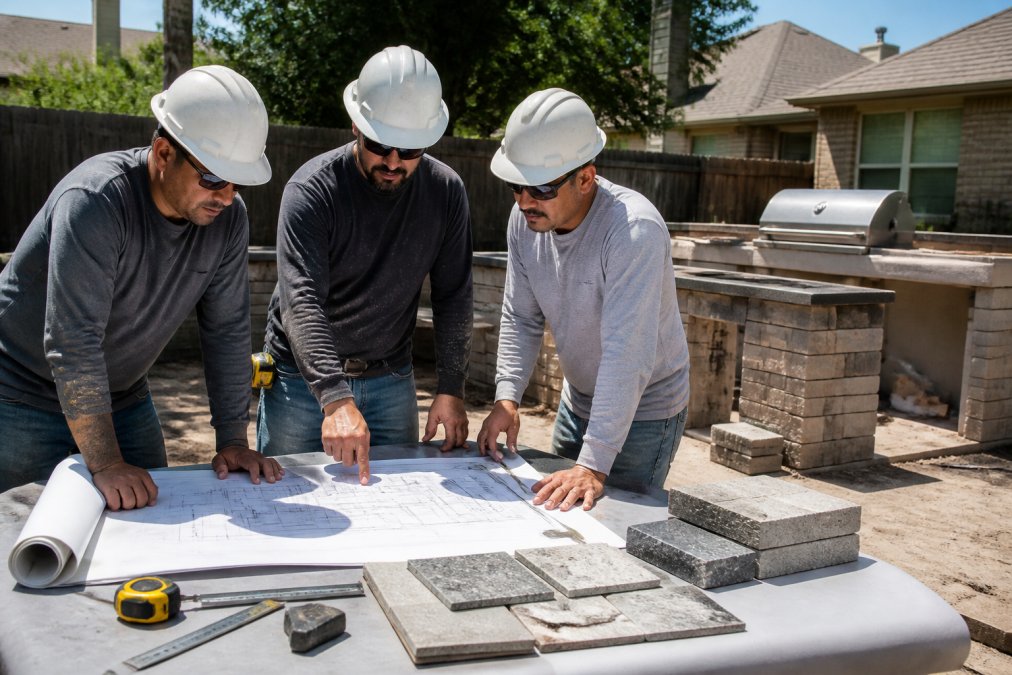
The process starts with a site assessment, where the contractor evaluates grading, access points, and existing utilities. The design phase produces the layout, material selections, and final cost estimate. Once you approve the plan and secure permits, construction begins.
Construction follows a predictable sequence: site preparation and excavation, footing and foundation work, then masonry, stone veneer, countertop installation, and appliance fitting. The final phase covers utility connections, finishing details, and cleanup.
| Phase | Typical Work | Key Consideration |
|---|---|---|
| Site Assessment | Grading review, utility location, access check | Identifies drainage and soil issues early |
| Design & Permitting | Layout, material selection, plan approval | Local codes vary by municipality |
| Foundation | Excavation, footings, concrete work | Requires proper curing time |
| Structure & & Finishes | Masonry, veneer, countertops, appliances | Weather delays are common |
| Final Walkthrough | Utility testing, cleanup, inspection | Confirm warranty terms in writing |
Best Materials for Outdoor Kitchens in North Texas Heat and Clay Soil
The best materials for outdoor kitchens in this climate prioritize thermal stability and resistance to ground movement, since summer surface temperatures can exceed 140 degrees Fahrenheit on dark materials and clay soil expansion stresses foundations.
For the structure, concrete block with steel reinforcement remains the industry standard because it handles weight and resists cracking. Stone veneer over the block provides the aesthetic finish without the cost and weight of full stone.
Countertop materials need to handle direct sun, temperature swings, and food preparation. Granite is a popular choice for its durability and heat resistance. Concrete offers a modern look but requires sealing to prevent stains. Avoid materials that absorb heat excessively or degrade under UV exposure.
Outdoor cabinetry demands weather-resistant construction. Stainless steel resists corrosion but can get hot in direct sun; polymer cabinets handle heat well and clean up easily. Your contractor should recommend options based on your kitchen's orientation and sun exposure.
Utility Planning: Gas Lines, Electrical, and Drainage Solutions
Utility planning determines whether your outdoor kitchen is a pleasure or a problem. Gas line installation requires a licensed professional who understands local code requirements, pressure testing, and safe connection procedures. Never allow an unqualified crew to run gas lines. construction cost breakdown.
Electrical work covers lighting, outlets, and connections for powered appliances. Outdoor-rated fixtures and GFCI protection are non-negotiable safety requirements, and your contractor should coordinate with a licensed electrician to ensure all work passes inspection.
Drainage solutions prevent the most common outdoor kitchen failure: water pooling around the structure. Proper grading directs rainwater away from the foundation, while a drainage system beneath the patio surface handles subsurface water. Without this planning, you risk erosion, foundation movement, and standing water after storms.
The permitting process ties all of this together. Most municipalities require permits for gas line installation and electrical work, and some require structural permits for permanent outdoor structures. A contractor who handles permitting as part of their service saves you significant hassle.
The ROI of a Built-In Grill Island and Outdoor Dining Area
Homeowners rarely build an outdoor kitchen purely for resale, but the question of whether it pays you back at sale time is legitimate, and the answer in the DFW market is more nuanced than a simple "yes."
What the Data Actually Shows
The National Association of Realtors' 2024 Remodeling Impact Report ranks outdoor kitchen additions among the top projects for enjoyment and cost recovery, with real estate agents estimating a 50 to 70 percent recoup at resale (nar.realtor). That is a national average, and DFW behaves differently: the metroplex has a strong year-round outdoor living culture, and in higher-price-point suburbs like Southlake, Frisco, and Highland Park, an outdoor kitchen is often a checkbox item for buyers.
The Integration Multiplier
The ROI is not determined by the kitchen alone but by how well it integrates with the rest of the hardscape. A grill island that stands alone on a pad reads as an afterthought, while a kitchen that connects to a covered patio, shares the same stone or pavers, and flows into a seating area reads as a designed outdoor room. Real estate agents in DFW consistently report that the integrated version adds measurable value.
The Appraisal Reality
Appraisers in DFW do not use a simple cost-per-square-foot formula for outdoor kitchens; they look for comparable sales in your neighborhood. If you are the only home on your block with a $40,000 outdoor kitchen, you will not get $40,000 back at appraisal because the appraiser has no comps to justify it. But if outdoor kitchens are common in your price range and neighborhood, the appraiser can point to recent sales that closed higher because of similar improvements.
The Cost Recovery Math That Matters
Consider realistic DFW numbers: a mid-range outdoor kitchen costs $35,000 installed. If you sell five years later, the buyer is paying for the fact that they do not have to build it themselves. In a market where a comparable kitchen would cost them $40,000 to build after closing, they will pay a premium typically between 50 and 70 percent of your original cost, per the NAR data. So you might recover $17,500 to $24,500 at sale; the remaining $10,000 to $17,500 is the cost of the years of enjoyment you got from the space.
The Tax Angle Nobody Mentions
There is a secondary financial benefit that rarely appears in outdoor kitchen articles. If you use a portion of your home for a qualified business purpose, the IRS allows depreciation on certain home improvements under Section 168 of the Internal Revenue Code. An outdoor kitchen attached to a primary residence used for occasional client entertaining does not typically qualify, but if you run a short-term rental or a home-based business that hosts clients, the rules change. Consult a CPA before assuming anything.
The Non-Financial Return That Drives Most Decisions
For most DFW homeowners, the real ROI is measured in the number of times the grill island gets used between March and November. A well-built outdoor kitchen extends your home's living space by several months each year, moves the party out of the kitchen, keeps cooking heat and smoke outside, and turns a backyard into a destination. Those benefits do not show up on an appraisal, but they are why most people make the investment.
How to Protect Your Investment for Resale
If resale value matters to you, keep three things in mind: choose materials that match your home's architectural style, keep the design flexible so a built-in grill can be replaced with a different brand or size in ten years, and keep all permits and inspection records. A clean paper trail eliminates a common negotiation point when the buyer's inspector asks whether the gas line and electrical work were permitted.
Why Moises Pizana Hardscapes Is a Top Choice for Turnkey Installation
For homeowners seeking professional outdoor kitchen installation DFW services, Moises Pizana Hardscapes delivers a turnkey experience that eliminates the coordination headaches common to multi-contractor projects. Our in-house crew handles the complete scope, from custom design and masonry work to appliance integration and final finishes.
We do not subcontract the work. Our team brings more than 15 years of experience and operates our own equipment, which means consistent quality control and accountability from the first site visit to the final walkthrough.
Our services extend beyond the kitchen itself. We build the surrounding hardscape, including patios, retaining walls, driveways, and walkways, so your outdoor kitchen integrates seamlessly into a larger outdoor living space. This lets us manage grading, drainage, and structural elements as one cohesive project.
Conclusion
Building an outdoor kitchen in DFW is a significant investment, and the quality of your contractor determines whether that investment appreciates or becomes a maintenance burden. Professional outdoor kitchen installation DFW projects succeed when the contractor brings structural knowledge, climate awareness, and a genuine commitment to craftsmanship.
Moises Pizana Hardscapes combines those qualities with a full-service approach that covers design, construction, and integration across your entire outdoor living space. Our in-house crew, specialized equipment, and 15 years of experience mean your project is built by the people who stand behind it. Get A Quote today and see how a custom outdoor kitchen can transform your backyard into the gathering place you have been imagining.
Frequently Asked Questions
How much does a professional outdoor kitchen installation cost in DFW?
Custom outdoor kitchen design cost depends on size, materials, appliances, and utility runs. A basic grill island with stone veneer and a built-in gas grill costs less than a full setup with a refrigerator, sink, searing station, and pellet grill. Countertop materials like granite or quartzite also affect the total. Because every project is site-specific, get a detailed quote from contractors like Moises Pizana Hardscapes rather than relying on online estimates.
How long does a professional outdoor kitchen installation take?
Most outdoor kitchen installation timelines run several weeks from signed contract to final walkthrough. Construction follows with concrete footings, masonry or steel framing, and utility hookups. Countertop fabrication and appliance installation finish the project. Weather delays and custom fabrication can extend the timeline. Ask your contractor for a written schedule before work begins.
What are the best materials for outdoor kitchens in Texas?
For North Texas, choose materials that handle intense summer heat and expansive clay soil. Concrete block with stone veneer or brick provides structural integrity and weather resistance. Use stainless steel for built-in appliances and outdoor cabinetry. Granite or sealed concrete works well for countertops. Avoid wood frames that warp with humidity changes. A proper base with drainage solutions prevents settling and cracking.
Should I hire a general contractor or a specialized hardscape company?
A specialized hardscape company with in-house crews offers better coordination for outdoor kitchen installation. General contractors often subcontract masonry, electrical, and gas line installation, which creates scheduling gaps. A dedicated team handles the full scope: site assessment, hardscape, masonry, utility planning, and project management. This single-point accountability reduces delays and ensures the structural work meets code.
Will an outdoor kitchen add value to my home?
A professionally built outdoor kitchen typically improves curb appeal and extends your outdoor living space, which buyers in DFW value. The return depends on matching the quality of your home and neighborhood. Built-in appliances, stone veneer, and a covered patio with lighting design offer the strongest return. Keep permits and warranties organized to show potential buyers the work was done properly.
Frequently Asked Questions
Q: How much does a professional outdoor kitchen installation cost in DFW?
A: Custom outdoor kitchen design cost depends on size, materials, appliances, and utility runs. A basic grill island with stone veneer and a built-in gas grill costs less than a full setup with a refrigerator, sink, searing station, and pellet grill. Countertop materials like granite or quartzite also affect the total. Because every project is site-specific, get a detailed quote from contractors like Moises Pizana Hardscapes rather than relying on online estimates.
Q: How long does a professional outdoor kitchen installation take?
A: Most outdoor kitchen installation timelines run several weeks from signed contract to final walkthrough. Construction follows with concrete footings, masonry or steel framing, and utility hookups. Countertop fabrication and appliance installation finish the project. Weather delays and custom fabrication can extend the timeline. Ask your contractor for a written schedule before work begins.
Q: What are the best materials for outdoor kitchens in Texas?
A: For North Texas, choose materials that handle intense summer heat and expansive clay soil. Concrete block with stone veneer or brick provides structural integrity and weather resistance. Use stainless steel for built-in appliances and outdoor cabinetry. Granite or sealed concrete works well for countertops. Avoid wood frames that warp with humidity changes. A proper base with drainage solutions prevents settling and cracking.
Q: Should I hire a general contractor or a specialized hardscape company?
A: A specialized hardscape company with in-house crews offers better coordination for outdoor kitchen installation. General contractors often subcontract masonry, electrical, and gas line installation, which creates scheduling gaps. A dedicated team handles the full scope: site assessment, hardscape, masonry, utility planning, and project management. This single-point accountability reduces delays and ensures the structural work meets code.
Q: Will an outdoor kitchen add value to my home?
A: A professionally built outdoor kitchen typically improves curb appeal and extends your outdoor living space, which buyers in DFW value. The return depends on matching the quality of your home and neighborhood. Built-in appliances, stone veneer, and a covered patio with lighting design offer the strongest return. Keep permits and warranties organized to show potential buyers the work was done properly.