 how-to
How to Calculate Retaining Wall Cost Per Linear Foot
Table of Contents
- Why Linear Foot Pricing Is the Standard for Retaining Walls
- What a Linear Foot Actually Measures
- The Core Formula: Length x Height x Material Rate
- Average Cost of Retaining Wall by Material
- Factors Affecting Retaining Wall Price
- Retaining Wall Installation Labor Costs Explained
- Common Mistakes That Inflate Your Estimate
- Frequently Asked Questions
Last Updated: September 16, 2026
Why Linear Foot Pricing Is the Standard for Retaining Walls
Knowing how to calculate retaining wall cost per linear foot is the fastest way to sanity-check any quote before you sign it. Contractors price retaining walls by the linear foot because it captures the two variables that drive nearly all the expense: how long the wall runs and how tall it stands. A wall's length determines how much material gets delivered and how many blocks get laid. Height determines how much excavation, drainage gravel, and reinforcement sit behind the face.
At Moises Pizana Hardscapes, we know that homeowners who understand this math ask sharper questions and get fewer surprises. That's the whole point of this guide.
What a Linear Foot Actually Measures
A linear foot is a 12-inch measurement along the face of the wall, taken horizontally from end to end, regardless of how tall the wall stands. It is a length measurement, not an area measurement, which is exactly why it needs a height multiplier to become a useful cost figure.
Think of it this way: when a contractor says a wall costs a certain amount per linear foot, that number assumes a specific height. A price quoted "per linear foot" for a 2-foot garden wall and the same phrase for a 5-foot structural wall are not comparable. Always ask what height the per-foot rate assumes before you compare bids. Clarifying these dimensional variables early in the bidding process remains the most effective method for avoiding hidden construction costs during the actual installation.
- Linear feet = total horizontal run of the wall face
- Square feet of face = linear feet x wall height
- Cost per linear foot = (material rate x height) + labor per foot
That middle line is where most estimates go sideways. Homeowners compare a per-foot number from one contractor against a per-foot number from another without checking whether both quotes assume the same height or the same base preparation.
The Core Formula: Length x Height x Material Rate
The core formula for retaining wall cost is: total cost = (wall length in feet) x (wall height in feet) x (material rate per square foot of face) + labor + site-specific add-ons. Everything else in a quote is a variation on this equation.
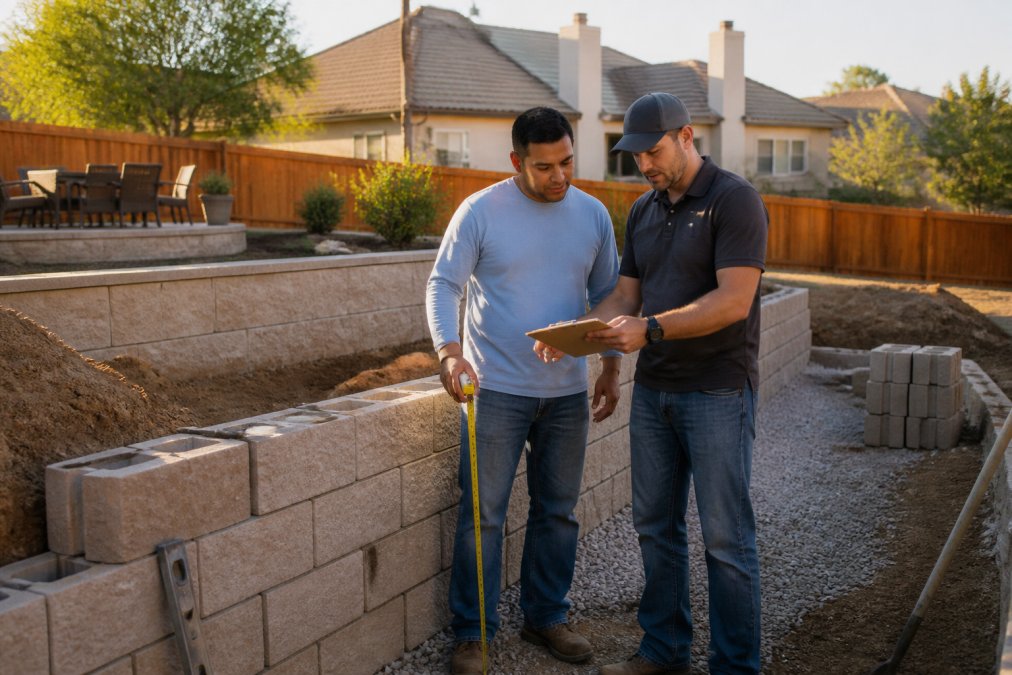
Step 1: Measure the Wall Length and Height
Run a tape measure along the full length of where the wall will sit, end to end, and write that number down in feet. Then measure height from the finished grade at the base to the top of the wall cap. For a wall that steps down a slope, measure each section separately rather than averaging, because material and labor scale per section.
Step 2: Convert Height to a Square-Foot Face Area
Multiply length by height to get the square footage of the wall face. A 30-foot wall that stands 3 feet tall gives you 90 square feet of face area. This is the number material suppliers and crews actually work from.
Step 3: Apply the Material Rate and Add Labor
Multiply face area by the material rate for your chosen block or stone, then add labor, base gravel, drainage aggregate, and any excavation or hauling. A common mistake is treating the material rate as the final price. It isn't. Base preparation and drainage usually account for a meaningful share of the total, and skipping them is how walls fail.
Average Cost of Retaining Wall by Material
Material choice is the single biggest lever on your per-foot number, and it's also where quotes vary most between contractors. Rather than quote you a figure that won't hold in your yard, here's how the major material categories compare on the factors that actually move price.
| Material | Relative Cost | Best For | Notes |
|---|---|---|---|
| Segmental concrete block | Moderate | Most residential walls | Consistent sizing, fast to install |
| Natural stone | Higher | Feature walls, visible areas | Irregular shapes slow installation |
| Poured concrete | Moderate to high | Tall structural walls | Requires forming and curing time |
| Timber | Lower | Short garden walls | Shorter lifespan, needs replacement |
| Boulder or riprap | Varies | Erosion control, slopes | Placement depends on site access |
For current material pricing in your area, request a quote rather than relying on a national average. Regional supply, delivery distance, and block availability all shift the number.
Factors Affecting Retaining Wall Price
Several site conditions can push a retaining wall price above the baseline formula, and most of them aren't visible until excavation starts. The three that catch homeowners off guard most often are access, soil, and water.
Site Access, Soil, and Drainage Conditions
Tight side yards, steep slopes, and fences that block equipment access slow down every phase of the build. When a crew has to move material by hand instead of machine, labor hours climb. Soil type matters too: expansive clay holds water and shifts, which usually means deeper base preparation and more drainage aggregate. Poor drainage is the most common reason walls bulge or lean within a few years, so a quote that skips drainage to hit a lower number is not a bargain.
Retaining Wall Installation Labor Costs Explained
Labor is typically the largest single line in a retaining wall installation labor cost breakdown, and it scales with complexity rather than just square footage. Two walls of identical size can carry very different labor charges if one sits on flat ground with machine access and the other climbs a slope in a cramped side yard.
What drives labor hours up:
- Excavation depth and soil hardness
- Hand-carrying material when equipment can't reach
- Wall height above the reinforcement threshold
- Drainage and backfill detailing
- Hauling away spoils
What keeps labor down:
- Clear equipment access from the street
- Consistent block sizing
- A straight or gently curved layout
- Dry, stable ground at the base
Ask any contractor to separate material and labor on the quote. A transparent breakdown tells you whether you're paying for craftsmanship or for a difficult site.
Common Mistakes That Inflate Your Estimate
The most expensive mistakes in retaining wall projects happen before a single block is laid, and they're almost always estimation errors rather than construction errors. Here are the ones we see most.
- Comparing per-foot prices at different heights. A 2-foot rate and a 5-foot rate are not the same product. Normalize both to square feet of face before comparing.
- Ignoring drainage in the budget. Drainage isn't optional on a retaining wall. Leaving it out of the estimate means paying for it later, often with interest in the form of a rebuild.
- Forgetting permits and engineering. Taller walls often require a permit and, in some cases, stamped engineering. Check with your local building department before you budget, and confirm what your contractor handles.
- Skipping the soil assessment. Expansive clay behaves differently than sandy loam. A quote built on the wrong soil assumption will change once digging starts.
- Choosing the lowest bid without reading the scope. The lowest number is only the lowest number if it covers the same work as the others.
For guidance on structural and drainage requirements, the International Code Council's building safety resources publishes reference material on wall construction, and the U.S. Environmental Protection Agency's stormwater guidance explains how proper drainage protects your property. Your local building department is the final authority on what your specific wall requires.
A retaining wall is one of the few hardscape investments that protects your property while improving how it looks, and getting the estimate right is the first step toward a wall that lasts.
Frequently Asked Questions
How much does a retaining wall cost per linear foot on average?
The retaining wall cost per linear foot varies widely with material and height. A short wall under 3 feet using basic concrete blocks sits at the low end, while taller walls with natural stone or engineered systems land much higher. Because pricing depends on your specific site, soil, and design, request a written quote rather than relying on a single national average.
Does the height of a retaining wall affect the cost per linear foot?
Yes, height is the single biggest driver of retaining wall cost. A 2-foot wall and a 6-foot wall may share the same length, but the taller wall needs deeper footings, more block courses, geogrid reinforcement, and often an engineered design. Most contractors price by square foot of wall face, so doubling the height roughly doubles the material and labor.
What materials are most cost-effective for retaining walls?
Segmental concrete blocks are usually the most budget-friendly option per square foot and install quickly. Pressure-treated timber costs less upfront but has a shorter lifespan in wet soil. Natural stone looks premium and lasts decades but carries the highest material cost. Your choice should balance upfront price against how long you plan to stay in the home.
Are there additional costs beyond materials for retaining walls?
Absolutely. Excavation, hauling away spoils, gravel backfill, drainage pipe, geogrid, and permits all add to the total. Walls over a certain height in many jurisdictions require a stamped engineering letter and a building permit. Always ask your contractor whether the quote includes drainage, compaction, and cleanup, since those items are frequently listed as separate line items.