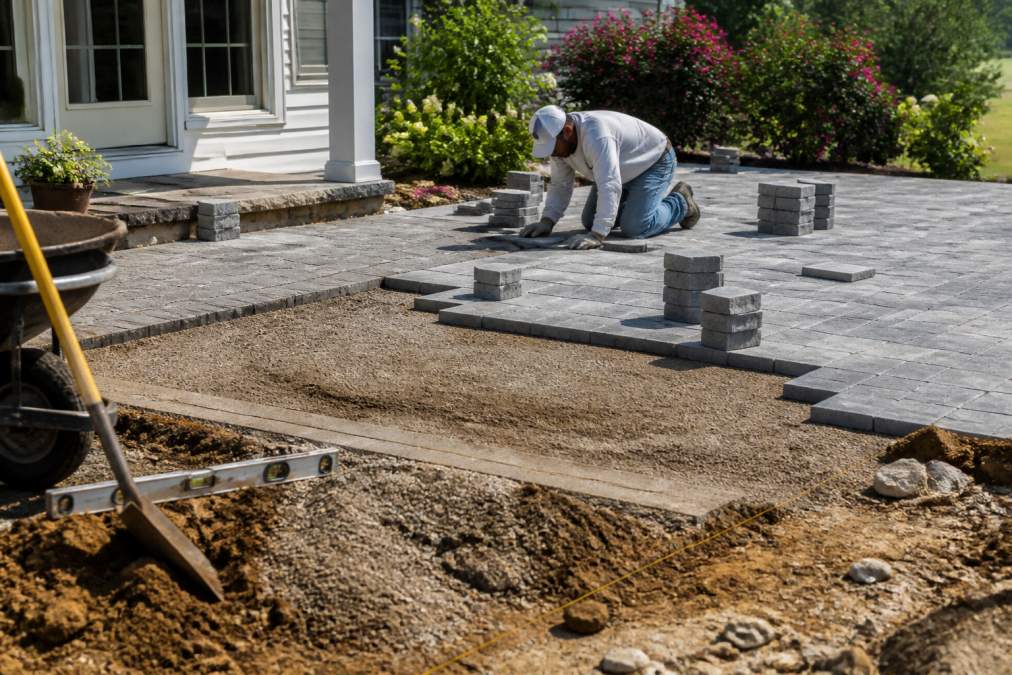
 how-to
How Long Does Patio Construction Take? A 2026 Guide
Table of Contents
- What Actually Drives Patio Construction Timelines
- Average Patio Construction Time by Size and Material
- The Patio Installation Process Steps, From Excavation to Joint Sand
- Factors Affecting Patio Construction Time That Most Homeowners Miss
- How Long to Wait Before Walking on Pavers (and Driving on Them)
- Hidden Site Conditions and Material Lead Times That Add Weeks
- Frequently Asked Questions
Last Updated: September 13, 2026
What Actually Drives Patio Construction Timelines
A paver patio typically takes 5 to 10 working days to build, but the full calendar timeline from signed contract to final walkthrough often runs 3 to 8 weeks (homeadvisor.com). This guide from Moises Pizana Hardscapes breaks down where the time goes so you can plan realistically.
Patio construction is the full sequence of site preparation, excavation, base installation, and surface finishing required to build a durable outdoor living surface. It is four or five separate jobs stacked in order, each depending on the last being finished correctly.
That distinction matters because how long does patio construction take has two honest answers: build days (crew on site) and calendar days (everything in between).
The Difference Between Build Days and Calendar Days
Build days are the hours a crew spends digging, compacting, laying, and finishing. Calendar days include permitting, material delivery, inspections, and weather. A job with 7 build days can easily stretch across 5 calendar weeks.
Most contractors quote build days because it sounds better. Ask for both numbers in writing.
Average Patio Construction Time by Size and Material
Small patios move fast. Large or custom-designed patios do not, and material choice changes the math more than most homeowners expect.
| Patio Type | Typical Build Days | Typical Calendar Time | Main Time Driver |
|---|---|---|---|
| Small concrete slab (under 200 sq ft) | 3-5 days | 2-3 weeks | Curing time |
| Small paver patio (under 200 sq ft) | 4-6 days | 2-4 weeks | Base prep, cutting |
| Mid-size paver patio (200-400 sq ft) | 6-10 days | 4-6 weeks | Excavation volume |
| Large paver patio (400+ sq ft) | 10-15 days | 6-10 weeks | Site access, drainage |
| Custom design with fire pit, seating wall | 15-25+ days | 8-14 weeks | Multiple trades, custom cuts |
Square footage is the biggest variable, but not the only one. A 300-square-foot patio with easy truck access and flat ground can finish faster than a 200-square-foot patio wedged behind a pool with a narrow gate.
Paver Patio vs. Concrete Slab: Side-by-Side Timelines
Concrete slabs are faster to install but slower to use, a slab needs curing time before you can walk on it or place furniture, while pavers can be walked on almost immediately after joint sand is swept in (concrete.org). Concrete wins on build days; pavers often win on usable days.
The Patio Installation Process Steps, From Excavation to Joint Sand
The patio installation process steps follow a fixed order, and rushing any step is the most common reason a patio fails early. Here is the sequence a professional crew works through.
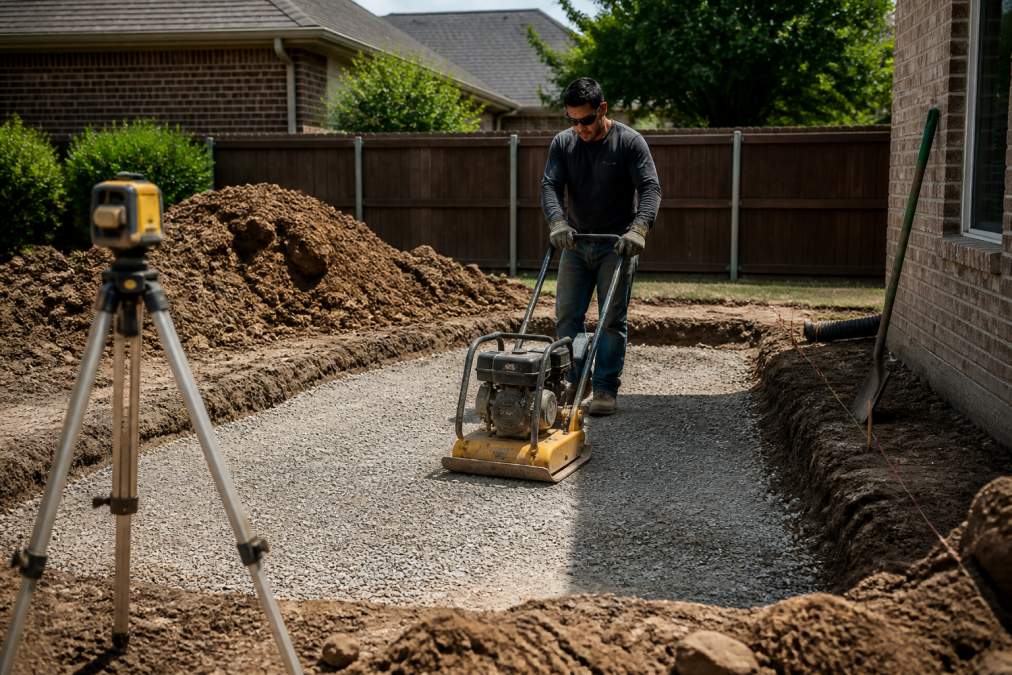
- Layout and marking. The crew stakes out the patio footprint and confirms elevations for drainage grading.
- Excavation. Soil is removed to the depth required for base layer, bedding sand, and pavers. This is the most labor-intensive phase.
- Sub-base preparation. Crushed stone is laid in lifts and compacted with a plate compactor. Geotextile fabric is often placed first to stop soil migration.
- Edge restraints. A concrete or steel edge is set to lock the pavers in place.
- Bedding sand and screeding. A level layer of sand is screeded to a uniform depth.
- Paver installation. Pavers are laid in the chosen pattern, with cuts made at edges and around obstacles.
- Compaction and joint sand. The surface is compacted, then joint sand is swept into the gaps and settled.
- Cleanup and final inspection.
Where the Clock Actually Goes During Installation
Excavation and sub-base preparation eat more time than any other phase, on a typical mid-size paver patio, they can consume half the total build days, while laying pavers is often the fastest part. A common mistake is underestimating compaction: lifts that are too thick or compacted too quickly settle later, and fixing that means tearing out finished work.
Factors Affecting Patio Construction Time That Most Homeowners Miss
The factors affecting patio construction time go well beyond square footage. Permitting, inspections, utility locates, weather, and labor availability routinely add weeks that never appear on a build-day estimate.
Permitting, Inspections, and Utility Locates
Many jurisdictions require a permit for patios above a certain size or height, or when work touches drainage or retaining structures. Permitting can take days to weeks depending on the local backlog, and the clock does not start until the application is complete, a missing site plan or setback drawing can reset your place in line.
Inspection timing is the part homeowners underestimate most. A typical sequence includes a pre-excavation or footing inspection, sometimes a base inspection, and a final inspection, each requiring a scheduled visit on the inspector's fixed route. If your crew finishes the base Thursday and the inspector cannot come until Tuesday, that is four dead days that never show up on a build-day quote.
Utility locates are usually required before any excavation. The national 811 service is free in most areas but must be requested several business days in advance, and private lines, irrigation, landscape lighting, gas lines to a grill or fire pit, invisible dog fencing, are not marked by the public service. Those need a private locator: commonly three to five business days for the public locate plus two to four for the private one, all before the first shovel moves. Securing these site clearances often runs parallel to navigating local planning permission requirements, which can add significant lead time to your project schedule.
Weather Delays and Seasonal Labor Availability
Rain stops excavation and compaction cold, a wet sub-base cannot be compacted to spec, so crews wait, and in storm-heavy seasons back-to-back systems can stack into a two- or three-week slip. Temperature matters too: concrete placed in cold weather needs blankets, accelerators, or heated enclosures, and polymeric joint sand has a minimum application temperature below which it will not activate and will wash out at the first hard rain (cement.org).
Seasonal labor availability is the factor most homeowners never ask about. In peak spring and early summer, quality crews are booked out weeks or months, so the gap between signing and the crew arriving can exceed the build itself. Booking in late fall, winter (where ground is workable), or early spring often means a faster start, fewer weather interruptions, and more crew attention. Build days are roughly fixed by size and complexity; calendar days depend on when you book and what the site reveals, so schedule early and lock material and design decisions before the crew is on the clock.
How Long to Wait Before Walking on Pavers (and Driving on Them)
You can typically walk on a paver patio as soon as joint sand is swept in and the surface is compacted, often the same day. Furniture can usually go back within a day or two. Vehicles are a different story: standard practice is to wait at least several days to a week before driving a car onto pavers, and longer for heavier vehicles, to let the base settle fully. Concrete is the opposite, a slab needs curing time before it carries load, and rushing that step causes cracking.
Hidden Site Conditions and Material Lead Times That Add Weeks
Two things derail timelines more than anything else, and neither shows up in a standard estimate: what is buried under the yard, and how long materials take to arrive.
Hidden Site Conditions That Force Extra Excavation
Hidden site conditions include old tree roots, buried debris, failing drainage, and unstable soil. Any of these can force extra excavation and base work that is rarely a one-day add.
- Tree roots. A mature root system under the footprint has to be cut back to a stable point and the sub-base rebuilt around it, left in place, roots heave the base and crack pavers within a season or two. Removal and rebuild can add two to five days on a mid-size patio.
- Buried debris. Old concrete footings, brick, scrap metal, and construction fill are common in yards built on or near previous structures. Debris must be excavated and hauled off, and the void backfilled and compacted in lifts, the same process as new base, just in a hole that was not in the plan.
- Poorly draining or expansive soil. Clay-heavy soils hold water and swell; expansive soils move with moisture. Both require over-excavation and replacement with a granular base, or the patio will heave and settle, a common reason a 'simple' patio turns into a two-week excavation.
- Failing existing drainage. If the yard already ponds near the patio footprint, the patio cannot be graded to shed water into a problem area. A French drain, dry well, or regrading is often added before the base goes in, a separate scope with its own days.
- Underground utilities and septic components. Private lines and septic tanks or leach fields are not always where the homeowner thinks. A locate that turns up a line through the middle of the planned patio forces a redesign, sometimes a few feet, sometimes a full re-layout.
Any of these can add days, and two or three together can add two to three weeks. A contractor who walks the site, probes the soil, and asks about the yard's history before quoting is protecting your timeline.
Material Lead Times and Seasonal Ordering Windows
Material lead times are the other quiet delay. Stock pavers, the common colors, sizes, and textures carried by local suppliers, can often be delivered in a few days, but specialty items are a different story:
- Special-order pavers and natural stone. Unusual colors, tumbled-edge finishes, and imported stone are frequently not stocked locally. Lead times commonly run two to six weeks, longer for imported material or custom runs.
- Out-of-stock or discontinued lines. A phased-out paver line may be available only in limited quantities, and matching dye lots across a partial shipment is not guaranteed, a real risk on large patios exceeding what one supplier has on hand.
- Hardscape accessories. Fire pit kits, seating wall caps, step treads, and lighting often have separate lead times from the pavers. A backordered fire pit insert can hold up the entire feature even after the patio surface is done.
- Concrete and aggregate. Ready-mix concrete is generally a short lead, but in peak season plant schedules fill up and delivery windows tighten. Crushed stone and sand are usually local and fast, though a specific gradation or decorative aggregate may not be.
Seasonal ordering windows matter because suppliers restock ahead of the busy season. Ordering in late winter or early spring often means shorter lead times and better availability than ordering in May or June when every crew is buying the same material.
How to Sequence Material and Site Work
The order that protects a schedule is: finalize design and material selection, confirm availability and lead time, schedule the utility locate, pull the permit, and only then schedule excavation. Homeowners who reverse that order, breaking ground first and picking pavers later, routinely lose two to four weeks waiting on material while a finished sub-base sits exposed. A simple rule: nothing gets excavated until the material is on site or on a truck with a confirmed delivery date.
Frequently Asked Questions
How long does it typically take to build an outdoor patio?
Most residential patios take one to three weeks of on-site work, but the full calendar timeline from contract signing to final walkthrough often runs three to six weeks. A simple 200 to 300 square foot paver patio with easy access can finish in about a week. Larger patios, complex custom designs, pergola installation, or outdoor kitchen additions push the schedule longer. Permitting, material lead times, and weather account for most of the gap between build days and calendar days.
How long before I can walk on a newly laid patio?
With a paver patio, you can usually walk on the surface as soon as the joint sand is swept and compacted, often the same day the crew finishes. Wait about 24 hours before placing heavy furniture or planters. Concrete slabs need longer: typically 24 to 48 hours before foot traffic and around seven days before vehicles, with full curing taking up to 28 days. Ask your installer for the specific schedule for your project.
What factors cause delays in patio construction?
The most common delays are permitting and inspection backlogs, rain that saturates the sub-base, utility line conflicts discovered during excavation, and material lead times on specialty pavers or custom stone. Site accessibility matters too: a narrow gate or steep slope slows every wheelbarrow load. Seasonal labor availability in the DFW area can also add days during peak spring and fall building months. A written schedule with buffer time helps keep expectations realistic.
Does the size of the patio affect the construction timeline?
Yes, but not in a straight line. Doubling square footage does not double the time because setup, excavation, and grading are largely fixed costs. A 400 square foot patio might take four to five working days, while 800 square feet could take seven to ten. The bigger jumps come from complexity: curves, multiple levels, seat walls, fire pits, and pergola installation each add their own build days on top of the base timeline.