 Comparison
Custom Outdoor Kitchen Financing: Options Compared
Quick Summary
Outdoor kitchen financing spreads the cost of a backyard cooking space over months or years, usually through a personal loan, a home equity product like a HELOC, or contractor promotional financing. Each option trades speed, cost and risk differently, so compare total interest and fees rather than the monthly payment alone.
- Personal loans are unsecured, so your house is not pledged, but rates usually run higher.
- A HELOC or home equity loan typically offers lower rates, but your home secures the debt.
- Deferred-interest promotions can charge full interest back if the balance is not paid in time.
- Lenders often look at credit score, debt-to-income ratio, and income stability.
- Borrow against a written scope plus a contingency of about 10 percent for surprises.
Table of Contents
- What Outdoor Kitchen Financing Covers and What It Doesn't
- Comparing Your Main Financing Options
- Backyard Improvement Loans: Qualifying and Approval Factors
- Outdoor Kitchen Financing With Bad Credit or No Credit Check
- Total Cost of Ownership: How Interest Rates and Terms Change the Real Price
- DIY Versus Professional Installation: How Financing Changes
- Outdoor Kitchen Payment Plans and Staged Funding
- Requesting a Quote and Planning Your Outdoor Kitchen Budget
- Frequently Asked Questions
What Outdoor Kitchen Financing Covers and What It Doesn't
Outdoor kitchen financing is a loan or credit product that spreads the cost of a backyard cooking space over months or years. It usually covers the build itself: the stone or masonry work, the grill and appliance hookups, the counters, the plumbing and gas lines, and sometimes the pergola or surrounding hardscape. It does not usually cover the land, the permits you pull on your own, or a yard you have not yet prepared for the work.
Many homeowners in the Dallas-Fort Worth area assume financing is a single product. It is not. Each option carries different rules for who qualifies, how the money arrives, and what happens to your home if you fall behind. Before you compare lenders, confirm what your financing will and will not pay for, because some offers cover only materials and leave labor to you.
Comparing Your Main Financing Options
Your three main routes are unsecured personal loans, home equity products, and contractor promotional financing. Each one trades speed, cost and risk differently. A quick comparison helps you decide which deserves a closer look.
| Option | Collateral Needed | Typical Use | Main Risk |
|---|---|---|---|
| Personal loan | None | Fast approval for mid-size builds | Higher fixed rate |
| HELOC or home equity loan | Your home | Large builds, lower rates | Your house secures the debt |
| Promotional contractor financing | Usually none | Deferred-interest offers | Full interest if not paid in time |
Personal Loans and Unsecured Credit
A personal loan is unsecured, which means you do not pledge your house. Lenders approve based mainly on your credit score, income and existing debt. Funds usually arrive within days after approval, which makes this route useful when your contractor needs a deposit quickly.
The tradeoff is cost. Unsecured rates tend to run higher than rates on loans backed by equity. Pay attention to the origination fee, the repayment term and whether the rate is fixed.
Home Equity Lines of Credit and Home Equity Loans
A home equity line of credit, or HELOC, works like a revolving account secured by your home. You draw money as the project needs it, which suits staged construction. A home equity loan pays a lump sum at a fixed rate instead.
Both usually offer lower rates than unsecured credit, but your home is the collateral. If you cannot make payments, the lender can foreclose (Mortgage refinance loans drove an increase in closed-end originations in 2020, new CFPB...). Only borrow against equity if your monthly budget can absorb the payment even if the project runs over.
Contractor Promotional Financing and Same-as-Cash Offers
Some contractors partner with lenders to offer promotional terms, such as a period with no interest. Many of these are deferred-interest deals. If you do not pay the full balance before the promotional window closes, interest may be charged back to the original purchase date (How to understand special promotional financing offers on credit cards). Read that clause before you sign.
Ask your contractor which lender they work with and request the full disclosure in writing. Availability depends on the contractor's participation, so this option is not guaranteed.
Backyard Improvement Loans: Qualifying and Approval Factors
Backyard improvement loans are personal or home-improvement loans sized for projects like outdoor kitchens. Whether you qualify comes down to how a lender reads four numbers: your credit score, your debt-to-income ratio, your income stability, and the loan amount relative to your income.
Credit score. Most lenders sort applicants into pricing tiers rather than approve or deny on a single cutoff. A common pattern is that the best advertised rates go to applicants in the top tier, with each tier below carrying a higher annual percentage rate.
Debt-to-income ratio. Lenders add up your monthly debt payments, mortgage or rent, auto loans, student loans, minimum credit card payments, and the new loan payment, and divide by your gross monthly income.
Income stability. Two years of steady employment or self-employment income is the common benchmark. Lenders may ask for recent pay stubs, the last two years of tax returns if you are self-employed, and bank statements. A recent job change within the same field usually does not disqualify you; a gap in income or a switch to commission-only pay may require more documentation.
Loan amount relative to income. A lender wants to see that the payment fits comfortably within your budget. A project estimate that is large relative to your income may trigger a smaller approved amount or a request for more down payment.
Expect to provide proof of identity, recent pay stubs or tax returns, bank statements, and the contractor's contact information and written estimate.
The loan amount should match the documented scope, not a round number you picked in advance.
Outdoor Kitchen Financing With Bad Credit or No Credit Check
Financing is harder to get with weak credit, but options exist. Some lenders focus on income and collateral rather than credit history, and some contractors offer in-house payment plans. Be cautious with any offer that skips the credit check entirely. Lenders that do not review credit often charge much higher rates or use short repayment windows that make payments hard to sustain.
If your credit is limited, consider a smaller first phase, such as the grill station and counter, and add features once you have paid down the balance. Building a payment history on a modest loan can improve your options for the next phase. A steady payment history can also help when you plan a larger renovation, since Luther Falls financing decisions often depend on how comfortably you can manage the next project’s payments.
Total Cost of Ownership: How Interest Rates and Terms Change the Real Price
The sticker price of a project is not the price you pay. Interest and fees add to the total, and the length of the loan changes it significantly. Most financing pages stop at the loan payment.
Start with the loan math. Multiply the monthly payment by the number of months in the term, then subtract the original amount financed. The result is your total interest and fees. Compare that figure across offers, not just the monthly payment. A longer term lowers the monthly payment but usually increases the total interest paid; a shorter term does the opposite.
Then add the costs the loan may not cover. A realistic total-cost-of-ownership estimate for an outdoor kitchen includes several line items beyond the build:
- Permits and inspections. Depending on your jurisdiction, a built-in gas grill, a sink with plumbing, or an electrical circuit may require permits and inspections. These are usually paid separately and are rarely rolled into a contractor's financing package.
- Utility hookups and upgrades. Running a gas line, adding an electrical circuit, or extending plumbing can require a licensed trade and may trigger an upgrade at the meter or panel. These costs are often discovered mid-project and are a common reason budgets run over.
- Site preparation and hardscape. A level patio, footings, and drainage are part of the project but sometimes sit outside the financed scope. Confirm what the loan covers before you sign.
- Ongoing maintenance. Stone, masonry, and outdoor appliances need sealing, cleaning, and occasional repair. Over the life of the loan, maintenance is a real cost that does not appear on any financing disclosure.
- Insurance and resale considerations. Confirm with your insurer whether the structure and appliances are covered, and expect that not every dollar spent is recovered at sale.
Interest rates change the real price over time. A variable-rate loan can rise after you sign, while a fixed rate stays the same. Over a five-year loan, even a small rate difference compounds into a meaningful change in total cost.
Weigh the loan against the value it adds. An outdoor kitchen can add to your property's appeal, but do not count on recovering the full financed cost at sale. A common approach is to treat the loan as a consumption decision with a partial value offset, not as an investment that pays for itself.
DIY Versus Professional Installation: How Financing Changes
Financing rules differ depending on who does the work. Most personal loans and promotional plans pay a contractor directly and require a signed scope of work. Some lenders will not fund DIY materials at all, or will fund only a portion of them.
If you plan to build part of the kitchen yourself, confirm with the lender what it will finance. Materials purchased through a retailer may qualify under a point-of-sale plan, while labor usually does not. Professional installation generally makes financing simpler because the contractor's invoice serves as the documented cost.
Professional installation also protects the financed investment. Stone and gas work carry safety requirements, and errors can be costly to correct. Weigh the cost of a mistake against the savings from doing it yourself.
Outdoor Kitchen Payment Plans and Staged Funding
A staged payment plan ties your money to project milestones rather than paying everything upfront. A typical schedule might include a deposit at signing, a payment after the base and framing are complete, and a final payment after the counters and appliances are installed and inspected.
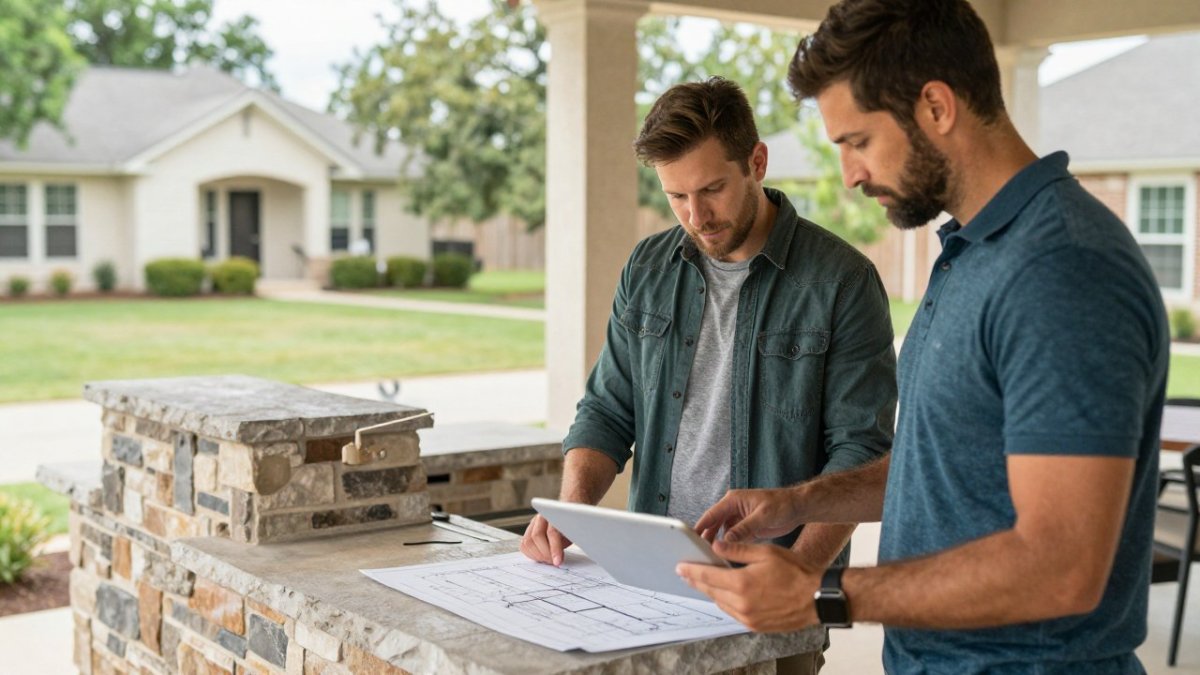
Staged funding protects you as well as your contractor. You pay for work as it is finished, which keeps the balance in line with the progress you can see. Ask your contractor to write each milestone and its payment amount into the contract.
If you use a HELOC, staged draws follow the same logic. You borrow as each phase is completed, so interest accrues only on the money you have actually used.
Requesting a Quote and Planning Your Outdoor Kitchen Budget
Start with a written scope that lists every component: the structure, the cooking station, the counters, the utilities, and the finish work. A detailed scope lets you compare quotes fairly and gives your lender a clear basis for the loan amount.
Set your budget before you request quotes. Decide the maximum monthly payment you can carry comfortably, then work backward to a total loan amount and term. Build in a contingency of about 10 percent for surprises such as utility upgrades or site conditions.
Pricing depends on design, materials, site conditions and timing, so we do not publish a fixed price for this work. To get an accurate figure for your yard, request a quote from Moises Pizana Hardscapes through our website.
Frequently Asked Questions
Can you finance a custom outdoor kitchen?
Yes. Custom outdoor kitchens are commonly financed through personal loans, home equity products, or promotional financing offered through a contractor. Lenders generally look at your credit score, income, and debt-to-income ratio rather than the type of project. Because pricing depends on design, materials, and labor, get a written quote from your installer first, then compare loan terms against that exact figure. Moises Pizana Hardscapes can provide a quote to use in that comparison.
Can I finance an outdoor kitchen with bad credit?
It is harder but not always impossible. Some lenders offer secured options, such as a loan backed by home equity, and some personal loan lenders work with lower credit scores at higher interest rates. A co-signer or a smaller project scope can also improve approval odds. Before applying, check your credit report for errors and compare the total repayment amount, not just the monthly payment, because higher rates can add significantly to the final cost.
Are there outdoor kitchen financing options with no credit check?
Some point-of-sale installment plans and retailer financing advertise soft or no credit checks, but they usually apply to modular kits or appliances rather than custom masonry construction. Labor-heavy projects typically require a credit review. Be cautious with any option that charges high fees or deferred interest that becomes due in full if you miss a payment. Read the agreement closely and confirm the total cost before committing.