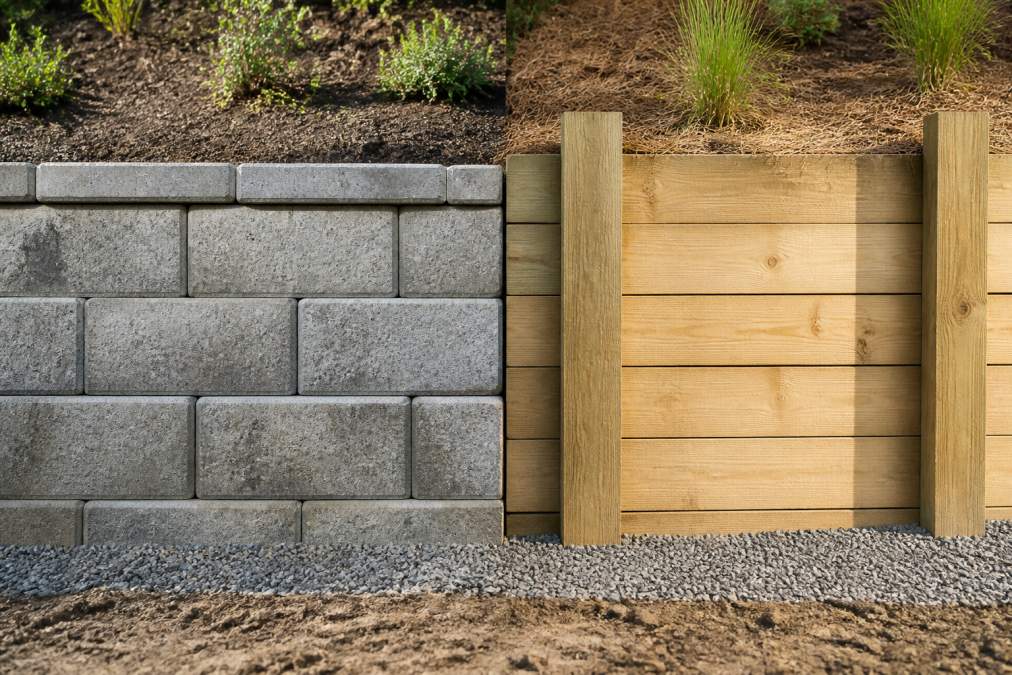
 comparison
Concrete vs Timber Retaining Walls for Drainage
Table of Contents
- Concrete vs Timber Retaining Walls for Drainage: Quick Comparison
- Pros and Cons of Timber Retaining Walls
- Benefits of Concrete Retaining Walls for Drainage
- Best Drainage Rock for Retaining Walls
- Retaining Wall Drainage Pipe Installation: Weep Holes, French Drains, and Backfill
- How to Fix Water Pooling in a Backyard Behind a Retaining Wall
- Cost, Longevity, and Climate Performance in North Texas
- Frequently Asked Questions
Last Updated: September 23, 2026
Concrete vs Timber Retaining Walls for Drainage: Quick Comparison
Choosing between concrete vs timber retaining walls for drainage comes down to one question: how long do you need the wall to manage water, and how much hydrostatic pressure will it face? Concrete wins on longevity and drainage integration, while timber wins on upfront cost and DIY appeal. This guide breaks down how each material performs when water is the enemy.
Most homeowners focus on the wall itself and ignore what happens behind it. That's backwards. FEMA guidance on flood-resistant landscaping makes clear that water management, not wall material, determines whether a retaining structure survives a heavy rain season. Below, we'll show you exactly how drainage design must change based on the material you pick, plus the rock, pipe, and backfill specs that actually work.
At-a-Glance Comparison Table
| Factor | Concrete | Timber |
|---|---|---|
| Service life | Decades with minimal care | Shorter, prone to rot |
| Load-bearing capacity | High, handles tall walls | Limited, best for low walls |
| Rot and insect risk | None | Constant threat |
| Drainage integration | Weep holes, gravel, geogrid | Weep holes, gravel, rebar |
| Upfront cost | Higher material cost | Lower material cost |
| Maintenance | Low | Regular inspection needed |
| Best for | Structural, tall, wet sites | Low garden walls, tight budgets |
How Each Material Handles Hydrostatic Pressure
Hydrostatic pressure is the force water exerts against a wall when it can't drain away. Both materials fail the same way when this pressure builds: the wall leans, cracks, or collapses.
Concrete resists lateral earth pressure better because of its mass and, when reinforced, its tensile strength. Timber flexes and bows under the same load, and wet wood decays faster at the base where pressure concentrates. The fix for both is the same principle: give water somewhere to go before it pushes on the wall.
Pros and Cons of Timber Retaining Walls
Timber's biggest advantage is cost and simplicity. Pressure-treated timber sleepers are lightweight, easy to cut on-site, and forgiving for a homeowner tackling a low wall. The trade-off is service life.
- Pro: Lower upfront material cost and easy transport
- Pro: Natural look that blends into garden beds
- Pro: Compatible with rebar anchoring for extra stability
- Con: Rot and insect damage despite treatment
- Con: Bows under sustained soil and water pressure
- Con: Needs frequent inspection, especially after wet seasons
Rot, Insects, and a Shorter Service Life
The thing nobody tells you about timber is that the base is where it dies first. Moisture wicks up from the soil, termites and carpenter ants find the softened wood, and within a few seasons a wall that looked solid starts to sag. Pressure treatment slows this, but it doesn't stop it. If your site stays wet, timber is a maintenance commitment, not a one-time purchase.
Benefits of Concrete Retaining Walls for Drainage
Concrete's core advantage is that it doesn't rot, warp, or feed insects. That matters most on wet sites where timber fails early. Modular systems like Allan Block use hollow-core blocks that can be filled with drainage aggregate, turning the wall itself into part of the drainage system.
- Moisture resistance that timber can't match
- High load-bearing capacity for taller walls and slopes
- Integrates cleanly with geogrid reinforcement
- Minimal maintenance over its service life
Load-Bearing Capacity and Structural Integrity
Structural integrity is where concrete pulls ahead decisively. A reinforced concrete wall can hold back significant soil loads, especially when geogrid ties the wall into the slope behind it. Timber walls are typically limited to lower heights because wood simply can't handle the same lateral earth pressure. If your wall needs to hold a slope, not just edge a garden bed, concrete is the safer engineering choice.
Best Drainage Rock for Retaining Walls
The best drainage rock for retaining walls is clean, angular crushed stone, typically 3/4-inch washed gravel. Avoid rounded river rock and anything with fines, because those trap water instead of letting it flow.
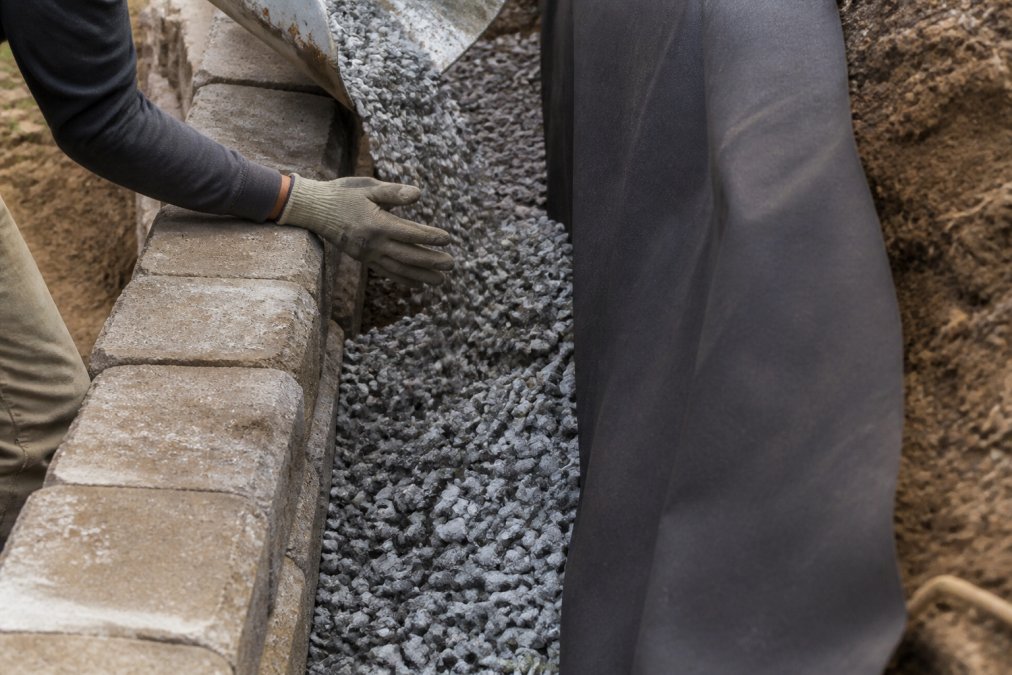
The rock goes in the drainage zone directly behind the wall, wrapped in geotextile fabric to keep soil from clogging the voids. This layer does two jobs: it lets water move down and out, and it reduces the hydrostatic pressure pushing against the wall. Get this wrong and even a well-built concrete wall will show stress cracks within a season.
Retaining Wall Drainage Pipe Installation: Weep Holes, French Drains, and Backfill
Retaining wall drainage pipe installation follows a clear sequence: excavate the trench behind the wall, lay perforated pipe in gravel, connect it to weep holes through the wall face, and backfill with drainage aggregate wrapped in fabric.
Here's the order that works:
- Dig a trench at the base behind the wall, sloped toward the outlet
- Line it with geotextile fabric
- Add a bed of washed gravel
- Lay perforated drainage pipe with holes facing down
- Cover the pipe with more gravel
- Wrap the fabric over the top to seal out soil
- Backfill with free-draining material, compacting in lifts
How to Fix Water Pooling in a Backyard Behind a Retaining Wall
Water pooling behind a retaining wall almost always means the drainage system is clogged, undersized, or missing. The fix starts with finding where the water is trapped.
Common causes and their solutions:
- Clogged weep holes: clear them and check the gravel behind for silt
- No French drain: add a perforated pipe and gravel trench
- Poor site grading: regrade so surface runoff flows away from the wall
- Compacted clay backfill: replace it with drainage aggregate
- No outlet: route the pipe to a safe discharge point downhill
Cost, Longevity, and Climate Performance in North Texas
The upfront price gap between timber and concrete is real, but it is the least useful number in the decision. What matters is the cost per year of service, and that calculation favors concrete far more than the sticker price suggests.
The Replacement Cycle vs. the One-Time Investment
Pressure-treated timber retaining walls have a finite service life (Long-Term Durability of Pressure-Treated Wood in a Severe Test Site). How long depends on soil moisture, drainage quality, and termite pressure, but the pattern is consistent: a timber wall that stays wet at the base will need repair or replacement well before a concrete wall shows meaningful wear. Each replacement resets the clock but also resets the cost, new material, new labor, new disposal of the old wall, and re-grading of the site.
How Freeze-Thaw and Moisture Hit Each Material
Freeze-thaw cycles are the quiet killer of retaining walls in this region. Water in the soil expands when it freezes, and that expansion pushes against the wall from behind. When it thaws, the soil shifts. Repeat that cycle through a winter and the wall is subjected to a slow, rhythmic load that undrained backfill cannot absorb.
What This Means for Clay-Heavy Soil
The local soil profile makes both problems worse. Clay holds water, expands when wet, and shrinks when dry. That shrink-swell cycle moves the soil mass against the wall repeatedly, and it also produces fines that can silt into a drainage zone over time. Geotextile fabric and clean, angular aggregate are not optional here, they are what keep the drainage system working through years of clay migration.
Budgeting for the Whole System, Not Just the Wall
We build retaining walls with the drainage engineered in from the start. Our crew has more than 15 years of experience, and we do not subcontract the work, so the same team that sets the base also installs the pipe and backfill. That is the difference between a wall that lasts and one that leans after the first big storm.
Frequently Asked Questions
Which is better for a retaining wall, timber or concrete?
Concrete wins for most projects because it resists rot, holds heavier loads, and lasts decades longer than timber. Pressure-treated timber costs less upfront and suits low walls under about 3 feet, but it decays over time and needs replacing. If the wall must manage significant water or support a slope, concrete is the more reliable long-term choice.
What type of rock is best for drainage in a retaining wall?
Clean, angular crushed stone between 3/4 inch and 1.5 inches works best. It lets water move freely and won't compact the way rounded gravel does. Avoid pea gravel and limestone dust, which clog with sediment. Place the stone in a column at least 12 inches wide behind the wall, and line the trench with geotextile fabric to keep soil from mixing in.
What is the 1/3 rule for retaining walls?
The 1/3 rule says the wall's buried base should equal about one-third of the exposed wall height. A 3-foot wall needs roughly 1 foot of base below grade. This depth anchors the wall against lateral earth pressure and frost movement. Walls taller than 4 feet usually need an engineer's review, especially where soil stays wet.
How do you prevent water buildup behind a retaining wall?
Combine three elements: a gravel backfill column, a perforated drainage pipe at the base that carries water away, and weep holes through the wall face. Cover the gravel with geotextile fabric so fine soil doesn't clog it. Grade the surface above the wall so runoff flows around it, not into the backfill. Without these, hydrostatic pressure builds and can crack or topple the wall.
Is it a good idea to use timber for a retaining wall?
Timber works for short walls, garden beds, and tight budgets, and it's easier for a homeowner to install. But pressure-treated wood still rots in North Texas soil within 10 to 20 years, and it offers less resistance to lateral earth pressure than concrete. If the wall holds a slope, sits near a foundation, or must last, concrete is the safer investment.